Inspiration for the poem “In Flanders Fields” by John McCrae
|
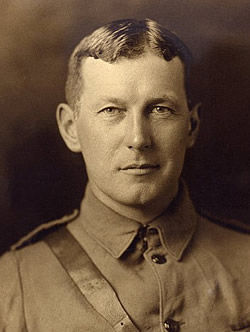
It is thought that doctor John McCrae (30 November 1872 - 28 January 1918) began the draft for his famous poem “In Flanders Fields” on the evening of the 2 May, 1915 in the second week of fighting during the Second Battle of Ypres.
John McCrae was serving as a Major and a military doctor and was second in command of the 1st Brigade Canadian Field Artillery. The field guns of his brigade's batteries were in position on the west bank of the Ypres-Yser canal, about two kilometres north of Ypres. The brigade had arrived there in the early hours of 23 April 1915.
It is believed that the death of his friend, Alexis Helmer, was the inspiration for McCrae's poem “In Flanders Fields”. The exact details of when the first draft was written may never be known because there are various accounts by those who were with McCrae at that time.
- One account says that he was seen writing the poem the next day, sitting on the rear step of an ambulance while looking at Helmer's grave and the vivid red poppies that were springing up amongst the graves in the burial ground.
- Another account says that McCrae was so upset after Helmer's burial that he wrote the poem in twenty minutes in an attempt to compose himself.
- A third account by his commanding officer, Lieutenant Colonel Morrison, states that John told him he drafted the poem partly to pass the time between the arrival of two groups of wounded at the first aid post and partly to experiment with different variations of the poem's metre.
The Death of Lieutenant Alexis Helmer
|
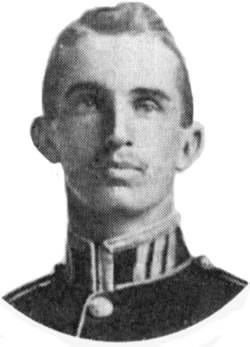
Lieutenant Alexis Helmer was an officer in the 2nd Battery, 1st Brigade Canadian Field Artillery. He had become good friends with John McCrae. On the morning of Sunday 2 May Alexis left his dugout and was killed instantly by a direct hit from an 8 inch German shell. What body parts could be found were later gathered into sandbags and laid in an army blanket for burial that evening.
Alexis was 22 years old and a popular young officer. Before the outbreak of war he had graduated from McGill University with a degree in Civil Engineering. He was the son of Elizabeth I. Helmer of 122, Gilmour Street, Ottawa, and the late Brigadier General R. A. Helmer.
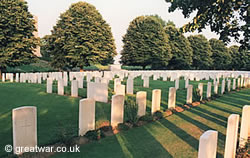
Near to the 1st Canadian Brigade's position on the canal bank there was a small burial ground which had originally been established by the French Army in the autumn of 1914, the previous year, during the First Battle of Ypres. Several months later the Second Battle of Ypres began on 22 April 1915. By early May 1915 the burial ground contained the graves of French and Canadian Army casualties. It became known as Essex Farm British Military Cemetery, after the farm in the vicinity named as Essex Farm on British military maps.
Lieutenant Helmer was buried on 2 May. In the absence of the chaplain, Major John McCrae conducted a simple service at the graveside, reciting from memory some passages from the Church of England's “Order of Burial of the Dead”. A wooden cross marked the burial place. The grave has since been lost. Lieutenant Alexis Helmer is now commemorated on Panel 10 of the Menin Gate Memorial to the Missing in Ypres; he is one of the 54,896 soldiers who have no known grave in the battlefields of the Ypres Salient.
The Burial Ground at Essex Farm
|
Lieutenant Colonel Morrison wrote about the small burial ground where Alexis Helmer was originally buried in May 1915:
“A couple of hundred yards away, there was the headquarters of an infantry regiment and on numerous occasions during the sixteen day battle, we saw how they crept out to bury their dead during lulls in the fighting. So the rows of crosses increased day after day, until in no time at all it had become quite a sizeable cemetery. Just as John described it, it was not uncommon early in the morning to hear the larks singing in the brief silences between the bursts of the shells and the returning salvos of our own nearby guns.” (3)
Publication of “In Flanders Fields”

|
During 1915 John McCrae sent the poem to The Spectator magazine. It was not published and was returned to him. It was, however, published in Punch magazine on 8 December 1915.
The version of the first line in the December 1915 publication of the poem in Punch magazine has the word “blow”. McCrae did also use the word “grow” in the first line in other handwritten and printed versions.
“In Flanders Fields”
Read the poem:
Related Topics
Essex Farm Military Cemetery
Find out more about how the cemetery developed from the early days of May 1915 when John McCrae was there. The remains of later concrete dressing station bunkers can still be seen there today.
Essex Farm Military CemeteryThe Menin Gate Memorial to the Missing, Ypres
|
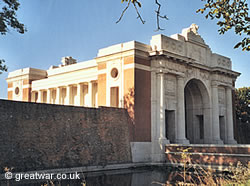
Find out more about the famous British memorial to the many thousands of British and Commonwealth soldiers who have no known grave in the Ypres Salient, and who are named on this memorial:
The Menin Gate Memorial to the Missing
Second Battle of Ypres, April-May 1915
Major John McCrae was second in command of the 1st Brigade Canadian Field Artillery in the Second Battle of Ypres. Read our innovative Battle Study on the build-up to the battle and the surprise trial gas attack north of Ypres on 22 April 1915 by the German Fourth Army.
Battle Study: Second Battle of Ypres
McCrae House, Guelph, Canada
Visit the website of the arts centre and museum at Guelph which was the birthplace of John McCrae.
Website: www.guelpharts.ca
Acknowledgements
(1) Photograph of John McCrae (public domain). William Notman and Son - Guelph Museums, Reference No. M968.354.1.2x Source Wikipedia: https://en.wikipedia.org/wiki/John_McCrae#/media/File:John_McCrae_in_uniform_circa_1914.jpg
(2) Photograph of Lieutenant Alexis Helmer. Featured in A Crown of Life: The World of John McCrae, by Dianne Graves
(3) From the papers of Edward W B Morrison, featured in A Crown of Life: The World of John McCrae, by Dianne Graves, p. 202
A Crown of Life: The World of John McCrae, by Dianne Graves
In Flanders Fields, The Story of John McCrae, by John F Prescott