WW1 Exhibitions, Conferences, Lectures & Commemorative Events
This page lists some of the many WW1 related public events taking place. For a list of events taking place in or around a particular battlefield area see the following pages:

Ypres Salient Events Somme Events

Do you have any Great War related events?

Send us an email to webmaster@greatwar.co.uk giving us the date, location, contact details and description of your event.

Remembering Fromelles

Saturday 7 August, 2010, 1.00pm to 5.30pm

Eastbourne College Theatre

£12.50 (£10.00 concessions). Refreshments included. Proceeds from ticket sales support charities SSAFA and Combat Stress.

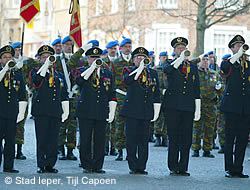
The Firing Party fire three volleys during the 19th July dedication ceremony at the new cemetery Pheasant Wood, Fromelles. Courtesy of CWGC
The Firing Party fire three volleys during the 19 July dedication ceremony at the new cemetery Pheasant Wood, Fromelles. 
					Photo: CWGC

Tommys Guides Military Books Specialists present a unique series of talks about the Fromelles Project.

The day event will comprise four sessions with speakers who have been closely involved in the Fromelles Project. Paul Cobb is an expert in the action at Fromelles in July 1916:

  • Session 1: The Battle of Fromelles, Paul Cobb. Author of “Fromelles 1916”.
  • Session 2: Remembering Fromelles, Julie Summers. Compiling editor and historian.
  • Session 3: The Archaeology & Finds, Kate Brady. Oxford Archaeology Team’s Finds Specialist.
  • Session 4: 20th Century Conflict Archaeology, Dr Nicholas Saunders, University of Bristol.

For full details, ticket sales and the event location go to the website Remembering Fromelles.

The Angel & The Fallen: A concert of Peace and Reconciliation

Saturday 11 September 2010 at 7.30pm

Salisbury Cathedral, Salisbury, Wiltshire

Ticketed event. Details and prices from Box Office, Salisbury Playhouse telephone 01722-320 333 or online from www.cathedralconcerts.co.uk. Proceeds from ticket sales will be donated to The Royal British Legion.

A concert featuring Hayley Westenra, The Band of the Adjutant General's Corps, the St. John Singers, English Youth Ballet and the Salisbury Cathedral Junior Choir.

Remembering Fromelles

to 30 January 2011

Imperial War Museum, Lambeth Road, London SE1 6HZ, UK

Admission Free

X-ray image of an Australian rising sun cap badge unearthed at Pheasant Wood, Fromelles. Courtesy of CWGC OA/Mark Farmer
X-ray image of an Australian rising sun cap badge unearthed at Pheasant Wood, Fromelles.

An exhibition using specially commissioned photographs to reveal the story behind the discovery of a mass grave of British and Australian servicemen near the village of Fromelles in northern France, and the construction of a new British military cemetery for their reburial. The soldiers were killed in the Battle of Fromelles, which took place as a subsidiary attack on 19th - 20th July to the north of the Battle of the Somme offensive of 1916. These British and Australian casualties were buried by German troops behind the German lines at a place known on British army maps as Pheasant Wood.

Work in progress on excavating graves one and two under the protective covering of an inflatable tent at Pheasant Wood, Fromelles. Courtesy of CWGC OA/Tim Loveless
Work in progress on excavating graves at Pheasant Wood, Fromelles.

The exhibition tells the story of the discovery of the graves in 2008. The excavation and the painstaking work carried out to identify the casualties where possible, and the creation of a new military cemetery has been overseen by the Commonwealth War Graves Commission (CWGC). The CWGC is responsible for the care and maintenance of the graves and memorials of 1.7 million men and women of United Kingdom and Commonwealth forces who died in the two world wars and later conflicts.

For information about the whole project and the event for the dedication of the new military cemetery at Fromelles on 19th July 2010 go to:

Commonwealth War Graves Commission: Remembering Fromelles

Horrible Histories™: Terrible Trenches Exhibition

to 31 October 2010

Imperial War Museum, Lambeth Road, London SE1 6HZ, UK

Adults: £4.95; Child: £2.50; Concessions: £3.95; Children under 4 years:Free

Find out about life in the terrible trenches during the First World War in a family exhibition.

Discover the barmy battleplans and foul food. See how soldiers dealt with lovely lice, gruesome gas, sickness and sores. Try on the curious clothing, climb through a mining tunnel and explore an officers’ dugout. Peer into no-man’s land with a periscope, smell the stenches and splat the rats!

This exhibition is based on the bestselling book series Horrible Histories™ written by Terry Deary and illustrated by Martin Brown.

War Horse

National Theatre

Mon Wed Fri 19:30, Tues 19:00, Thu Sat 14:30 & 19:30 Booking up to 23 October 2010

New London Theatre, Drury Lane, London, UK

Tickets £15.00 to £49.50

War Horse War Horse

The award-winning smash hit War Horse is now playing at the New London Theatre. Based on a story by Michael Morpurgo

The First World War is the backdrop for this tale of bravery, loyalty, and the extraordinary bond between a young recruit and his horse. Actors, working with astonishing life-sized puppets by the internationally renowned Handspring Puppet Company, take audiences on an unforgettable journey through history.

At the outbreak of World War One, Joey, young Albert's beloved horse, is sold to the cavalry and shipped to France.

He's soon caught up in enemy fire, and fate takes him on an extraordinary odyssey, serving on both sides before finding himself alone in no man's land.

But Albert cannot forget Joey and, still not old enough to enlist, he embarks on a treacherous mission to the trenches to find him and bring him home.

The book on which the play is based came about after Michael Morpurgo had a chance conversation in his local pub nearly 30 years ago with an old soldier who had been to the First World War as a 17 year old ‘with ‘orses’ as he said. He discovered that over a million horses died in that dreadful war – and that was just on the British side – and that most of them that survived were sold off after the war was over, to butchers in France.

Photographer: Simon Annand