The Last Post Ceremony, Ieper — Ypres, Menin Gate
The Daily Ceremony
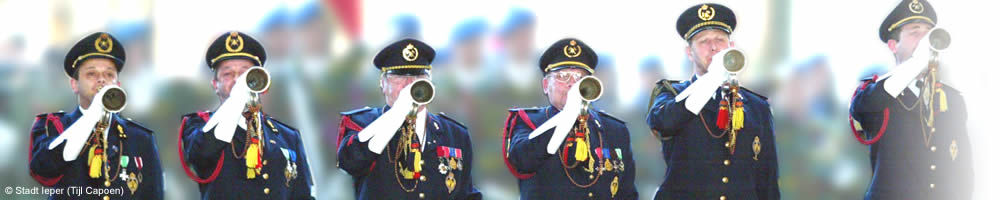
Every night at 8.00pm (20:00 hours) a moving ceremony takes place at the Menin Gate in Ieper - Ypres. The Last Post Ceremony has become part of the daily life in Ieper (Ypres) and the local people are proud of this simple, moving tribute to the courage and self-sacrifice of those who fell in defence of the town.
- 7.00 pm: People Gather at the Menin Gate
- 7.30 pm: The Traffic is Stopped
- 7.55 pm: The Buglers Arrive
- 8.00 pm: Sounding of Last Post
- Take Part & Lay a Wreath at the Ceremony
- Hear Last Post and Réveille
- How the Tradition Began
- The Origin of ‘Réveille’ and ‘Last Post’
- The Ypres Bugles
- The Last Post Association
- Location of the Last Post ceremony, Menin Gate Memorial
- Arrangements for Car & Coach Parking
7.00pm: People Gather at the Menin Gate
Some evenings, particularly in summer, there can be a large crowd of visitors. At other times, on a weekday or in winter, there may be fewer visitors. Whether there is a large crowd or not even one person there, every evening at 8 o'clock members of the Last Post Association play “Last Post”.
7.30pm: The Traffic is Stopped
|
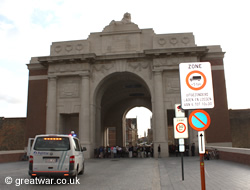
At 7.30pm the police arrive and all traffic is stopped from driving through the Menin Gate Memorial.
For a short time each day the noise of traffic echoing around the Menin Gate from the cobbled road ceases.
The crowd is hushed. A stillness descends over the memorial.
7.55pm: The Buglers Arrive
|
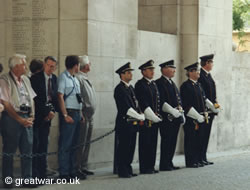
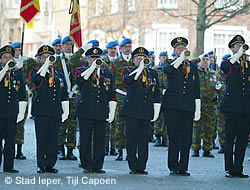
Buglers of the Last Post Association arrive and stand ready at the eastern entrance of the Menin Gate Memorial. It is a tradition that the buglers of the Association should wear the uniform of the local volunteer fire brigade, of which they are all required to become members.
The Buglers then step into the roadway under the memorial arch. The Buglers stand in a line across the eastern entrance facing towards the town.
8pm: Sounding of Last Post
|
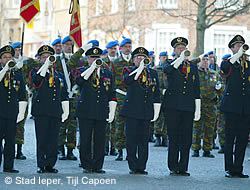
This is a solemn, dignified event and all those attending are respectfully requested not to clap at the end of the proceedings.
Daily Ceremony
(When no participants or wreath layers are present)
- At 8pm - 20:00 hours - 8 o'clock
- Call to Attention by the buglers of the Last Post Association.
- Sounding of the “Last Post” bugle call.
- Minute of silence.
- Sounding of the “Réveille” bugle call.
- End of Ceremony
An Extended Last Post Ceremony
(When participants and/or wreath layers are present)
|
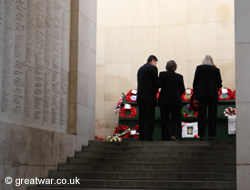
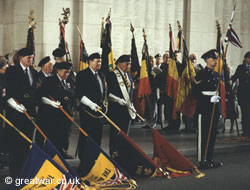
On occasions the ceremony may be extended after the sounding of “Last Post” and before the sounding of “Réveille”. The extended ceremony may include music by a visiting band, choir, orchestra, or a parade with Standards and military personnel.
Anyone wishing to lay a wreath is invited to do so. Members of the Last Post Association (all volunteers) are on duty for the daily ceremony and they will inform visiting individuals and groups who are laying wreaths what to do and when to lay their wreath.
The extended ceremony comprises:
- At 8pm - 20:00 hours - 8 o'clock
- Call to Attention by the buglers of the Last Post Association.
- Sounding of the “Last Post” bugle call.
- Exhortation
- Minute of Silence
- Lament (if a piper is present)
- Wreath laying
- Sounding of the “Réveille” bugle call.
- End of Ceremony
The Exhortation
|
After the wreath-laying a member or guest of the Last Post Association, a visiting dignitary or a visitor will have been invited to say the words of the Exhortation, taken from Laurence Binyon's poem “For the Fallen” (fourth verse). Standing in the centre of the road under the arch of the Hall of Memory the person will say the words:
“They shall grow not old, as we that are left grow old:
Age shall not weary them, nor the years condemn.
At the going down of the sun and in the morning,
We will remember them.”
Read the full poem by Laurence Binyon, first published published in The Times newspaper on 21 September 1914.
Take Part & Lay a Wreath at the Ceremony
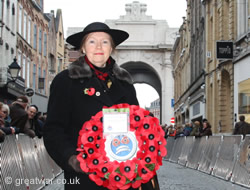
If you wish to lay a wreath, or participate as a Standard Bearer, band or parade with an organised group you should contact the Last Post Association to request this in advance. Wreath layers must provide their own wreath. Every assistance will be provided by the Last Post Association during the ceremony. Information and contact details are provided on the Last Post Association website:
Website: lastpost.be/ceremony/participate
Last Post Association App: Taking Part in the Last Post Ceremony
An app is available to explain all you need to know about taking part in a ceremony. You can go to the Last Post Association website for a link to download the app:
Website: lastpost.be/media/last-post-app
How to Order a Remembrance Wreath, Chaplet, Spray or Cross

Wreaths of various sizes can be ordered from the Royal British Legion. A donation is requested.
To see the available wreaths, chaplets, sprays, crosses plus additional ribbons and regimental badges on the Royal British Legion website, with details on how to place an order. Emergency requests can be dealt with for short notice requests but may incur additional delivery costs:
Website: www.britishlegion.org.uk Wreaths
Telephone: +44 (0)345 845 1945 (Mon-Fri 10.00 - 17.00 hours)
Hear Last Post and Réveille
|
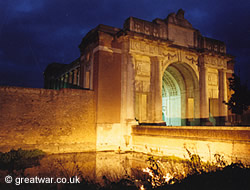
Hear extracts from the daily ceremony under the Menin Gate. These recordings were made in the 1990s:
(These soundfiles are the copyright of www.greatwar.co.uk and may not be reproduced without permission.)
How the Tradition Began
|
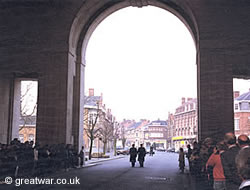
On 2 July 1928, a year after the inauguration of the Menin Gate Memorial on 24 July 1927, a number of prominent citizens in Ypres decided that some way should be found to express the gratitude of the Belgian nation towards those who had died for its freedom and independence.
The idea of the daily sounding of the Last Post - the traditional salute to the fallen warrior - was that of the Superintendant of the Ypres Police, Mr P Vandenbraambussche. The Menin Gate Memorial on the east side of Ypres was thought to be the most appropriate location for the ceremony. Originally this was the location of the old city gate leading to the Ypres Salient battlefields and The Menin Road, through which so many British and Commonwealth troops had passed on their way to the Allied front line.
The privilege of playing Last Post was given to buglers of the local volunteer Fire Brigade. The first sounding of Last Post took place on Monday 2nd July 1928 and a daily ceremony was carried on for about four months. The ceremony was reinstated in the spring of 1929 and the Last Post Committee (now called the Last Post Association) was established. Four silver bugles were donated to the Last Post Committee by the Brussels and Antwerp Branches of the Royal British Legion.
From 1 May 1929 the Last Post has been sounded at the Menin Gate Memorial every night and in all weathers. The only exception to this was during the four years of the German occupation of Ypres from 20 May 1940 to 6 September 1944. The daily ceremony was instead continued in England at Brookwood Military Cemetery, Surrey. On the very evening that Polish forces liberated Ypres the ceremony was resumed at the Menin Gate, in spite of the heavy fighting still going on in other parts of the town. Bullet marks can still be seen on the memorial from that time.
When the Last Post returned to Ieper (Ypres) after the Second World War the Brookwood Last Post Association (under Colonel McKay) continued, until recent years, to sound the Last Post at Brookwood Military Cemetery on the first Sunday of the month.
The Origin of ‘Réveille’ and ‘Last Post’
The tradition of sounding a bugle or drum at various stages of a soldier's day originated in the British Army. In the military camp at the start of the day a wake-up bugle call called ‘Réveille’ from the French word “réveiller” - to wake up - would be played. At various times of the day inspections would be made of each sentry post and a bugle call played at each post.
The tradition of the final bugle call of the day signalling the end of the soldier's day dates back to the 17th century when the British Army was on campaign in the Netherlands. There was already a Dutch custom in existance called “Taptoe”. This was a signal at the end of the day to shut off the beer barrel taps and the name comes from the Dutch “Doe den tap toe” - “turn the tap off”. From that time the British Army adopted a routine of also sounding drum beats as the officer on duty made his rounds in the evening to check sentry posts and to call off-duty soldiers out of the pub and back to their billets. When the bugle call of ‘Last Post’ was sounded at the final sentry post inspection this was the final warning that everyone should be back in their billets.
The ‘Last Post’ bugle call is used at military funerals, memorials and times of Remembrance. It symbolises the ‘end of the soldier's day’ in so far as the dead soldier has finished his duty and can rest in peace.
The Ypres Bugles
|
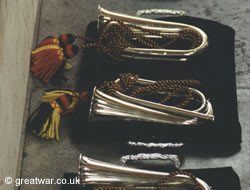
In the 1950s two silver bugles were presented by the Old Contemptibles' Association of Blackpool and Fleetwood and two silver trumpets were presented by Colonel I Whitaker to the memory of former Cavalry and Artillerymen.
New Bugles from the Royal Corps of Transport (1992)
By the early 1990s the six bugles which had been presented to the Last Post Association in 1929 and the 1950s were beginning to lose their tone. They had been blown every night for 60 years without interruption, except for the period of German occupation in the Second World War.
In 1992 six new silver bugles were presented to the Last Post Association. The idea to give new bugles, to ensure the daily act of Remembrance might continue for many more years to come, was that of retired Lieutenant Colonel Graham Parker, OBE. Graham was responsible for arranging this gift from serving personnel of the Royal Corps of Transport, now amalgamated into the Royal Logistic Corps.
The official hand-over of the new bugles was carried out in July 1992 at a ceremony to mark the 65th anniversary of the dedication of the Menin Gate.
New Bugles from the Royal British Legion (2007)
Eight new bugles were presented to the Last Post Association by the Royal British Legion in July 2007 on the occasion of the sounding of Last Post at the Menin Gate for the 27,702nd time.
The Last Post Association
|
The Last Post Association is responsible for the arrangements and sounding of “Last Post” at the daily ceremony at the Menin Gate Memorial.
Information about the volunteers who are responsible for carrying out the act of Remembrance every day and how you can become a member to support the daily Last Post ceremony.
Website: www.lastpost.be
Location of the Last Post Ceremony at the Menin Gate Memorial
The Last Post ceremony takes place at the Menin Gate Memorial on the east side of the town of Ypres.
Access to the Menin Gate for the Ceremony
Access to the Memorial is easiest on foot. There is parking in nearby streets or in the Grote Markt (market square), which is a few minutes' walk away. Visitors to the ceremony gather on the pavements under the Menin Gate either side of the road.
Great care should be taken if crossing the road at the Memorial before and after the ceremony. Young visitors should be aware not to run into the road at any time. This is a busy main road and the road is only closed to traffic for the duration of the daily Last Post ceremony and on special occasions.
Arrangements for Car & Coach Parking
For car parking and coach parking/drop-off points you can find information on the Ieper Tourist Office website:
Website NL: www.visitieper.be Praktisch
Website EN: www.visitieper.be City maps, Parking, Coaches
Related Topics
Menin Gate Memorial to the Missing
|
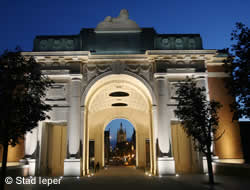
The Memorial commemorates the names of over 54,000 officers and men of the United Kingdom and Commonwealth Forces who died in the Ypres Salient before 16 August 1917 and who have no known grave.
Menin Gate Memorial to the Missing
11 November Armistice Day Commemorations in Ypres
11 November is a public holiday in Belgium. A special Last Post ceremony is held at the Menin Gate Memorial at 11.00 hours and various other commemorative events also take place in Ypres-Ieper on that day.
Armistice Day Commemorative Events in Ypres - Ieper
Acknowledgements
Header photo: Original photo of Last Post Association Buglers: courtesy of the Ieper Tourist Office, Stad Ieper: copyright Tijl Capoen.
(1) Photograph courtesy of the Ieper Tourist Office, Stad Ieper: copyright Tijl Capoen.
(2) Photograph courtesy of the Ieper Tourist Office, Stad Ieper: copyright Tijl Capoen.
The Last Post Association. Visit the website at:
Website: www.lastpost.be
Before Endeavours Fade, by Rose E B Coombs, MBE
The Brookwood Last Post Association


