Hill 60 Memorial and its History
60 Metres Above Sea Level
|
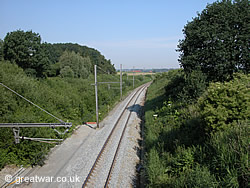
The WW1 battle area known as Hill 60 was so called on British military maps because the contoured height of the ground was marked at 60 metres above sea level. This high ground was man-made in the 1850s, having been created by the spoil from the cutting for the railway line between Ypres and Comines. The railway line was opened in March 1854.
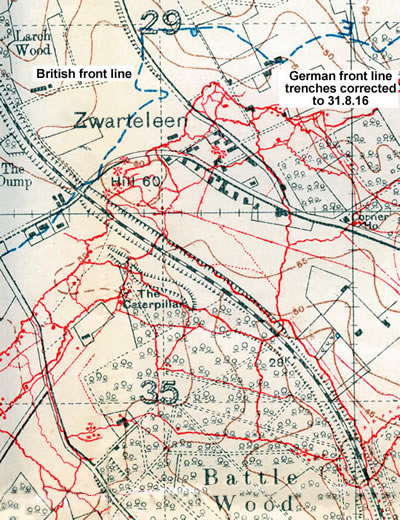
Hill 60 and the railway line in a cutting are shown on the British trench map 28 N.W.4. & N.E.3 (trenches corrected to 31.8.16). Before the war this hill was known locally as “Côte des Amants”, which translates into English as “Lover's Knoll”.
A Battlefield Memorial Site
|
The Memorial Site on Hill 60 is maintained by the Commonwealth War Graves Commission. It is a site which was the scene of desperate fighting in April and May 1915 between the British and German armies. The launch of a British attack on 17th April 1915 began with the explosion of three mines which literally blew the top off the hill.
Hundreds of soldiers lost their lives on this small area of ground at that time and owing to subsequent fighting across the ground later in the war it was not possible to recover or identify many of them at the end of the war.
Tunneling and mining operations were carried out here by French, British, Australian and German soldiers. If tunnels caved in or were blown in by the enemy the soldiers who died underground were usually left where they died because of the difficulty of retrieving them. The remains of many soldiers, therefore, still rest in this site.
Visitors are reminded to be respectful that this is a memorial site.
Battlefield Remains
|
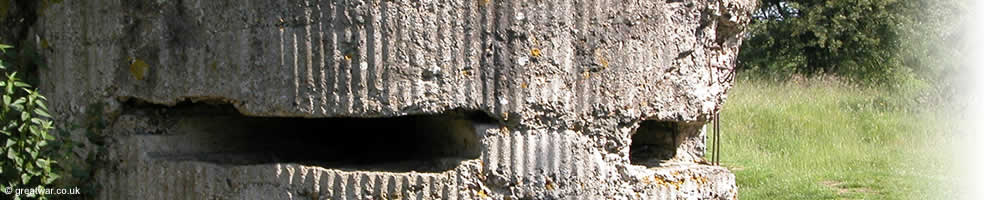
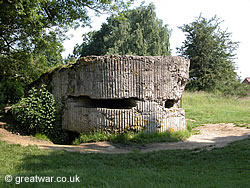
The Memorial Site also has the remains of several concrete bunkers and craters from the 1915/16 and 1917 battles.
A large bunker in the centre of the site is preserved almost as it was found at the end of the war. It was used by both German and British Armies.
Queen Victoria Rifles Memorial
A memorial to the Queen Victoria Rifles (9th Battalion The London Regiment) was replaced after the original was damaged during the Second World War.
2nd Lieutenant Woolley Awarded the Victoria Cross
Second Lieutenant Geoffrey H Woolley was serving with this battalion in the fighting at Hill 60 in April 1915. On the night of 20-21 April he and a handful of men were the only defenders on the hill and continually repelled attacks to hold the position. He encouraged the men to hold the line against heavy enemy machine gun fire and shellfire. For a time he was the only officer on the hill. When he and his men were relieved on the morning of 21 April only 14 out of a company of 150 had survived.
For his gallantry he was awarded the Victoria Cross which was the first one to be awarded to a Territorial Officer.
1st Australian Tunneling Company Memorial
|
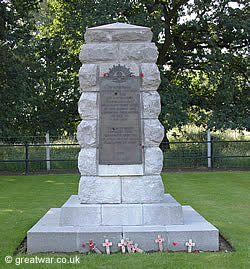
Next to the entrance gate to the Hill 60 Memorial Site there is a memorial to the 1st Australian Tunneling Company.
The inscription reads as follows:
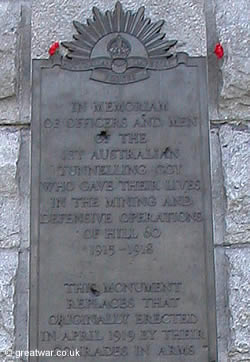
“In Memoriam of Officers and Men of the 1st Australian Tunneling Coy who gave their lives in the mining and defensive operations of Hill 60 1915-1918.
This monument replaces that originally erected in April 1919 by their comrades in arms. 1923”
Second World War Bullet Damage
|
The memorial has bullet holes in the metal plaque from Second World War fighting in the Ypres area as shown on the enlarged photograph.
14th Light Division Memorial
|
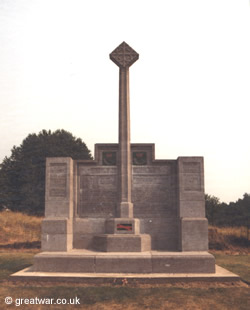
This memorial was moved to this location from Railway Wood, a few kilometres north of Hill 60 because of subsidance. It is now located just outside the perimeter of the Hill 60 Memorial Site next to the Australian Tunneling Company memorial.
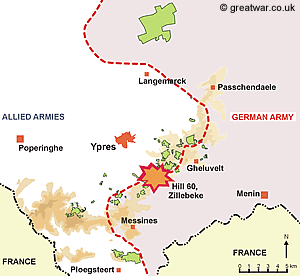
Location of Hill 60 Memorial
Hill 60, Zwarteleenstraat, Zillebeke-Ieper, Belgium
Latitude N 50° 49' 27 " ; Longitude E 2° 55' 43 "
Latitude 50.824597; Longitude 2.930267
Leave Ypres on the Rijselsstraat via its southern exit through the Lille Gate and over the moat. At the roundabout go straight on into the N336 Rijselsteenweg. After about 500 metres there is a left turn just before the railway crossing. Turn left here onto a minor road called Konenseweg in the direction of Hollebeke. Approximately 4.5 kilometres along this road there is a left turn to Zwarteleen called Zwarteleenstraat. Continue for about 200 metres when you will drive over the Ypres-Comines railway. Hill 60 is on the right immediately after the railway bridge. There is a parking area large enough for a coach to park.
Access to Hill 60 Memorial
|
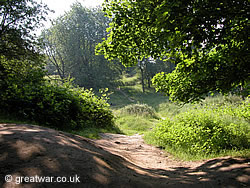
Access to the Hill 60 Memorial Site is by a metal gate and is open daily (not restricted to specific opening hours). Visitors are reminded that it is a former battle site and although there are natural paths from the entrance, the site is grassy and the ground is uneven.
A Commonwealth War Graves Commission Site
Hill 60 Memorial Site is maintained by the Commonwealth War Graves Commission (CWGC). For more information about the work of the CWGC and the cemeteries and memorials maintained by this organisation go to the CWGC website:
Website: www.cwgc.org
Related Reading

Hill 60, Ypres (Battleground Europe)
by Nigel Cave

Excellent guidebook in the Battleground Europe Series. Includes photos, maps and lots of historical information about this important site. 160 pages. Published by Pen & Sword Books Ltd; First Edition edition (5 Sep 1997); ISBN-10: 0850525594 and ISBN-13: 978-0850525595

Beneath Hill 60 (paperback)
by Will Davies
The amazing true story of the men in the 1st Australian Tunneling Company, which dug the mine destined as one of the 19 huge mines to be exploded under Hill 60 at the start of the Battle of Messines in the early morning of 7 June 1917. 288 pages. Published by Bantam (30 Sep 2010), ISBN-10: 085750049X and ISBN-13: 978-0857500496

Beneath Hill 60 (DVD)
from the book by Will Davies, starring Steve le Marquand, Chris Haywood. Directed by Jeremy Sims.
The amazing true story of the men in the 1st Australian Tunneling Company, which dug the mine destined as one of the 19 huge mines to be exploded under Hill 60 at the start of the Battle of Messines in the early morning of 7 June 1917. Momentum Pictures Home Entertainment. Released 11 Oct 2010.
Related Topics
|
Battles of the Ypres Salient
See an overview of the battles which took place in the Ypres Salient.
Battles of the Ypres Salient 1914-1918
Cemeteries & Memorials on the Ypres Salient Battlefields
See our listings with photographs and locations for the many cemeteries and memorials to be visited on the battlefields of the Ypres Salient.
Cemeteries in the Ypres Salient Monuments and Memorials in the Ypres Salient