Talbot House (Toc H), Poperinge: A Living Museum
|
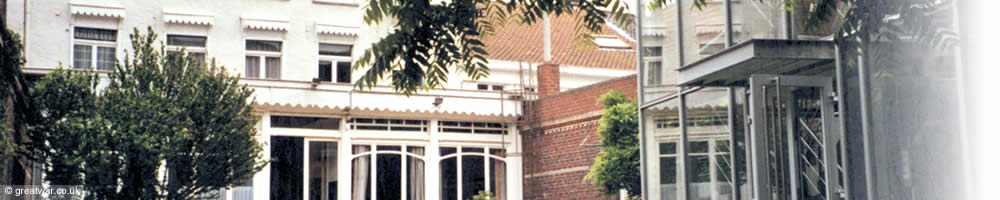
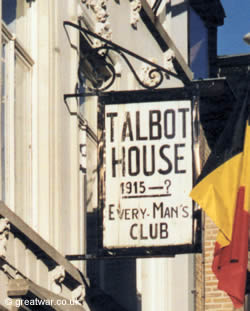
Talbot House (Toc H) today is a living museum.
Thousands of British soldiers passed through Talbot House during the three years it was open from the end of 1915. It was a place where rank was left at the front door. There was always an urn of tea on the go. There were books and comfortable chairs. There was even a chapel furnished by the soldiers in the hop loft at the top of the house. In spite of the rumble of the guns in the distance, it was a quiet and unique place behind the British lines where men could spend time relaxing, writing letters and meeting with serving friends, brothers and fathers, in what must have felt like a British “home-from-home”.
Many well-known personalities visited the house during the Great War. Some left works of art behind and these original paintings and drawings are still in the house today. Photographs depicting life at this Every-Man's Club and in the Ypres Salient can be viewed in “The Old House”.
For the story about how Talbot House (Toc H) was founded in 1915 see our page at:
The Story of Talbot House (Toc H)
The House was also the foundation of the worldwide Christian Toc H Movement.
The Restored Concert Hall
|
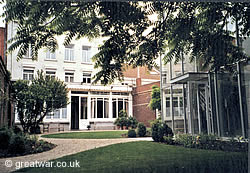
The renovation of the former hop store, which was listed as an official monument in 1998, took several years. The building was in decay when it was purchased. Thanks to the financial support from the Town of Poperinge, the Flemish Government and the European programme EFRO, the monument could be restored in its original state. Extra care was spent on the relics of industrial-archaeological heritage remaining in the building.
One of these relics can be seen on entering the building. The old lift mechanism to pull up bales of hops was set up in its original place. This is also the case for the old hop drying areas, and the original brick floor of the store, which had disappeared under a layer of concrete over the years.
For the refurbishment of the restored Concert Hall, help was brought in from Event Communications of London. Unique artefacts from private collections returned to Talbot House. Family members of deceased veterans were contacted and provided the exhibition with unique objects and diary fragments. Also the co-operation with the photographic and film archives of the Imperial War Museum in London resulted in unique and authentic footage for the exhibition.
The Visitors' Tour
The Visitors' Tour highlights the different buildings and the garden by presenting them in a logical order. The visit includes a mixture of presentations and showcases, the garden, a film, authentic locations and a slide show.
1. “Life behind the Lines” Exhibition
The ground floor of the hop store (the renovated Concert Hall) is dedicated to the exhibition “Life behind the Lines”. It tells about Poperinge and its neighbouring area during the First World War. Poperinge was situated about 10 miles behind the front lines of the Ypres Salient, right in the middle of the British sector. In 1916 and 1917 there were about 250,000 British soldiers in and around Poperinge although it had only had 20,000 inhabitants in peace time.
The exhibition follows Tubby Clayton, the inspiration and soul of Talbot House, on a journey through his photo album with themes such as the medical help for the injured, interaction between the soldiers and inhabitants, war logistics, and ensuring that the fighting spirit was maintained (medals for the brave and punishment for deserters). These themes are presented by one person and are illustrated with images, objects, quotations from diaries, letters and authentic documents. For example, the famous American brain surgeon, Dr Harvey Cushing is the central figure for medical help and Lt. John Gamble describes life in the tent camps.
2. The garden – “the largest room in the House”
|
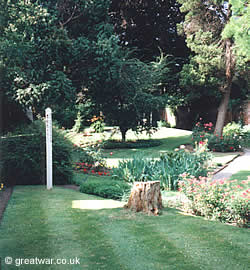
After the introductory exhibition, the visitor enters the garden. Tubby Clayton himself named it "the largest room in the House". For soldiers who had to live for days at a time in a world of mud and shot-up trees, the garden was an oasis of rest and peace. The lay-out of the garden has been restored as it was during the Great War. It has been recently listed as a monument by the Belgian Monument and Landscapes service.
In the 1980s the garden at Talbot House was badly in need of renovation. Lieutenant Colonel (Retired) Graham Parker, OBE arranged for a team of volunteer Servicemen from the British Army base of Emblem, near Antwerp, to visit the house at weekends. The garden was reconstructed in keeping with the original layout and Princess Alexandria visited the House on its completion. A sign from this Military Unit has been left in the garden in appreciation of their work.
3. The Slessorium
|
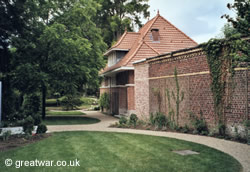
When leaving the garden visitors arrive at “the Slessorium”, named after Major Paul Slessor, who built it. Nowadays the building tells the story of Talbot House by means of the new Talbot House film which plays a central role. Tubby not only tells his mother the stories about Talbot House, but the visitor as well. Another striking artefact in the Slessorium is Tubby’s hut, in which he lived during the evacuation of Poperinge, caused by a German offensive in spring 1918. After the war, Chaplain Tubby Clayton took this hut back to the UK, and after 90 years the hut has returned to Belgium. Part of the hut is now decorated with the personal objects of the Chaplain.
4. The Old House
|
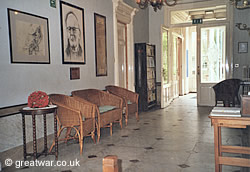
Visitors, who also want to feel the atmosphere of Talbot House, can enter the Old House itself. The interior is authentic and the objects displayed are still in use today. A new asset to the House is the opening of the Chaplain’s room, which was Tubby’s room during the Great War.
5. The “Concert Party”
After the peaceful and quiet atmosphere of Talbot House, visitors can go to the first floor of the former hop store, the actual Concert Hall. It was this room that became the stage for many recreational activities in 1917. Visitors are shown a film of a concert given by the performers “The Happy Hoppers”. Sentimental and happy songs, jokes and dances are brought together in a non-stop show and this gives a good idea of how things were in 1917. One of the actors in the film is Mr Lester Simpson from Derbyshire, who is famous for his musical contribution to the peace concerts in Passchendaele, and the threesome “Cope Boys & Simpson”.
Talbot House Shop
A museum shop sells a range of postcards and souvenirs of a visit to Talbot House.
Visitor Information
Opening Hours
- Open Tuesday - Sunday from 10.00 to 17.30 hours. Last admission 16.30 hours
- Closed: Mondays except for pre-booked group visits.
- Christmas closure: Contact Talbot House for dates.
Admission Charges
For admission charges for individuals visit the Talbot House website.
Website: www.talbothouse.be Entrance fee for individuals
A group size is a minimum of 15 persons. Group visits should be reserved at least 14 days in advance. Visits can be booked by downloading a form and returning it by email. The form is avavailble here:
Website: www.talbothouse.be Entrance fee for group visits
Location
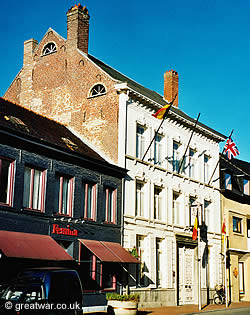
Talbot House is located at 43 Gasthuisstraat, in one of the streets leading from the main square in Poperinge town centre. The entrance and exit to the museum is in Pottestraat, just around the corner from the front door of Talbot House.
Accommodation at Talbot House
|
Accommodation for individuals and small groups in the bedrooms of “The Old House” is offered on a self-catering basis and a fully equipped kitchen is at your disposal. There is additional accommodation available in the modern guestrooms in the Garden House. Reservations must be made in advance.
See the Guesthouse section on the Talbot House website for full information about the accommodation.
Website: www.talbothouse.be In the House
Contact Details
Address: Talbot House vzw, Gasthuistraat 43, 8970 Poperinge, Belgium
Telephone: +32 (0)57 33 32 28
Email: info@talbothouse.be
Website: www.talbothouse.be
Related Topics
The Story of Talbot House (Toc H)
|
Find out how this famous “Old House” came into being, who founded it and why it is called Talbot House or Toc H:
The Story of Talbot House (TOC H)
Museums in the Ypres Salient
For listing of all the WW1 related museums in the Ypres Salient battlefield area see our page at:
Related Reading

A Song in the Night
by Julie Maria Peace
A novel about how the lives of two people, Rosie and a man fighting on the Western Front almost a century earlier, become entwined as the result of Rosie's chance discovery in a bookshop. The story features visits to Talbot House (Toc H) by soldiers in the First World War. ISBN-10: 1908596635 and ISBN-13: 978-1908596635.
Acknowledgements
Talbot House Association