Moina Belle Michael and the Flanders Fields Memorial Poppy

|
A young American teacher, Miss Moina Belle Michael, had an idea for a Flanders Fields Memorial Poppy in November 1918.
In her autobiography, ”The Miracle Flower, The Story of the Flanders Fields Memorial Poppy” (published in 1941) Moina described how the idea for a memorial emblem of a red poppy came to her in a moment of revelation. Moina dedicates the book to the late Colonel John McCrae and writes that his poem “In Flanders Fields” was the inspiration for her Flanders Fields Memorial Poppy.
The Flanders Fields Memorial Poppy Idea

|
The inspirational moment for the Memorial Poppy is described in Chapter VIII of “The Miracle Flower”. The chapter is entitled, “The Birthday of the Flanders Fields Memorial Poppy Idea”. The text is reproduced here with permission from Dorrance Publishing Company.(2)
On Saturday 9 November 1918 Moina was on duty for the Twenty-fifth Conference of the Overseas Y.M.C.A., which was being held at Hamilton Hall, Columbia University in New York City. She was in a room called the “Gemot”. It was a large, rectangular, gloomy room with tables and chairs, which was often used as a 'get-together' place. Soldiers, sailors and marines sometimes came to this room as a place to say farewells to mothers, sisters, wives and girlfriends before embarking for service overseas.
The extracts of text from Chapter VIII read as follows:
“On Saturday morning before Armistice, during the Twenty-fifth Conference of the Overseas Y.M.C.A. War Secretaries, November 9, 1918, a young soldier, the son of A. G. Kneble, New York City, Executive Secretary to the War Personnel Board of National War Workers Council, the governing board of our staff of the Y.M.C.A. Secretaries for Overseas, placed a copy of the November Ladies Home Journal on my desk at Headquarters. About 10:30 o'clock, when every one [sic] was on duty elsewhere, I found time to read it and discovered the marked page which carried Colonel John McCrae's poem, ‘We Shall Not Sleep’, later named ‘In Flanders Fields’. It was vividly picturized - most strikingly illustrated in color.”

|
The poem ‘We Shall Not Sleep’ (‘In Flanders Fields’) was reproduced next to a black and white image of the colour illustration from the Ladies Home Journal.
Moina continued:
“I read the poem, which I had read many times previously, and studied its graphic picturization. The last verse transfixed me — ‘To you from failing hands we throw the Torch; be yours to hold it high. If ye break faith with us who die, we shall not sleep, though poppies grow in Flanders Fields’.
This was for me a full spiritual experience. It seemed as though the silent voices again were vocal, whispering, in sighs of anxiety unto anguish, ‘To you from failing hands we throw the Torch; be yours to hold it high. If ye break faith with us who die we shall not sleep, though poppies grow in Flanders Fields’.
Alone, again, in a high moment of white resolve I pledged to KEEP THE FAITH and always to wear a red poppy of Flanders Fields as a sign of remembrance and the emblem of ‘keeping the faith with all who died’.
In hectic times as were those times, great emotional impacts may be obliterated by succeeding greater ones. So I felt impelled to make note of my pledge. I reached for a used yellow envelope, turned the blank side up and hastily scribbled my pledge to keep the faith with all who died.”
Moina's poem written in reply, ‘We Shall Keep the Faith’, was included in the chapter.
Moina's story continued as follows:

|
“At that moment three men, as a committee from the Twenty-fifth Conference, appeared at my desk to bring a check [sic] for ten dollars from the Twenty-fifth Conference in appreciation of my efforts to make a home-like Hostess House of their headquarters. I had furnished the flowers before that time from by own purse, and I was not even a “dollar a year man”. It was a pleasant surprise to find this appreciation, and, looking up from my intese reverie of dedication, I replied: “How strange. I shall buy red poppies — twenty-five red poppies. I shall always wear red poppies — poppies of Flanders Fields! Do you know why?” Then I showed them the illustrated poem of Colonel John McCrae. The Committee was duly impressed and requested the permission to take the material with them back to the Conference room, “Old number Three, Hamilton Hall”.
The Conference was equally pleased and after adjournment the men came down asking for red poppies to wear. This is the first group-effort asking for poppies to wear in memory of all who died in Flanders Fields.
I had no poppies at our headquarters, but promised I would get them that afternoon down in the city. It never occurred to me the difficulty I would have in finding artificial poppies of Flanders Fields in the novelty shops of New York City.
That Saturday afternoon, before Armistice, November 9, 1918, I went down poppy hunting in New York City. After visiting several novelty shops which featured artificial flowers and failing to find red poppies, I went to Wanamaker's. After searching in the flower collections I found a large red poppy, which I bought for my desk bud-vase and two dozen small silk red four-petaled poppies, fashioned after the wild poppies of Flanders. Having made the purchase I told the pretty little Jewess, who served me, why I was searching for single petaled red poppies. She was quite sympathetic, for her brother was then sleeping among the poppies behind the battlelines of France in a few-months' old soldier's grave. This personal contact with such a personal reaction further convinced me that this choice of a remembrance emblem for those sleeping in Flanders Fields was no accident but a logical one.
When I returned to duty at our headquarters for the evening hours the men came crowding again for poppies to wear. I had pinned one on my cloak collar, and gave out the others until the last of the twenty-five red poppies was pinned on a lapel of a Y.M.C.A. secretary of the Twenty-fifth Conference, who would soon be on his way to France to do his bit. I wore my poppy until I reached home in February, when I made some fresh ones.
Since this was the first group ever to ask for poppies to wear in memory of our soldier dead, and since this group gave me the money with which to buy them, I have always considered that I, then and there, consummated the first sale of the Flanders Fields Memorial Poppy.”
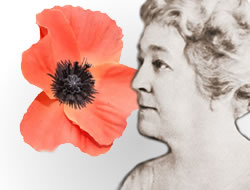
“The Poppy Lady”
|
As a result of her tireless campaigning for recognition of the Flanders Fields Memorial Poppy Moina became known as “The Poppy Lady”.
After the First World War Veterans' organizations began to adopt the red poppy as a symbol of Remembrance for those who had lost their lives and for fund raising for the welfare and care of those who had served and survived the Great War of 1914-1918.
Organizations Adopting the Red Poppy as their Emblem
1918
- 9 November, 1918: The Twenty-fifth Conference of YMCA Overseas Secretaries, Columbia University, New York City
- 4 December, 1918: The Twenty-eighth Conference of YMCA Overseas Secretaries, Columbia University, New York City
1919
- 6 February, 1919: The Calvary Baptist Church, New York City
- 9 April, 1919: The Home Economics Club, Hannibal, Missouri
- Summer, 1919: Several patriotic organizations in Georgia
1920
- 20 August, 1920: Georgia Department American Legion
- 29 September, 1920: The National American Legion
- October 1920: The American and French Children's League, France
1921
- 5 July 1921: The Great War Veterans' Association of Canada
- September 1921: The Auxiliary to the National American Legion
- Autumn 1921: The Earl Haig's British Legion Appeal Fund, Britain
- Autumn 1921: Returned Soldiers and Sailors Imperial League, Australia
- Autumn 1921: New Zealand Returned Soldiers and Sailors Association
1922
- May 1922: Veterans of Foreign Wars (USA)
The Story of the Remembrance Poppy
Find out more about the red poppy as an emblem of Remembrance, and how it has raised funds for the physical and mental welfare of ex-Servicemen and women:
The story behind the Remembrance PoppyRelated Topics

|
Acknowledgements
(1) Photograph of Moina Michael in“The Miracle Flower”, reproduced by courtesy of Dorrance Publishing Co. Inc.
(2) “The Miracle Flower” is out of copyright. Nevertheless, permission to reproduce the text from chapter VIII was sought from the original publisher and is reproduced courtesy of Dorrance Publishing Co. Inc.
(3) Image reproduced by courtesy of Dorrance Publishing Co. Inc.
Website: www.dorrancepublishing.com
The Miracle Flower, by Moina Michael