French Flanders and Artois Battlefields of WW1, France

Images of sites to visit on the French Flanders and Artois battlefields, France.
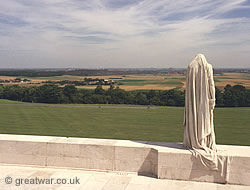
Looking north-east across the Lens-Douai plain of Artois from the high ground of the Vimy Ridge and the Canadian National Vimy Memorial.
Looking north-east from the Canadian National Vimy Memorial across the Lens-Douai plain.

The 1914-1918 battlefields of French Flanders are located in an area of northern France historically called the provinces of Flanders and the County of Artois. Nowadays these two provinces are situated in the northernmost region of France, namely Nord-Pas-de-Calais. This region shares its northern border with Flemish Flanders in Belgium. Towns and villages in the area which feature in the battlefields of 1914-1918 are Armentières, Arras, Bailleul, Béthune, Bullecourt, Festubert, Fromelles, Hazebrouck, Loos-en-Gohelle, Monchy-le-Preux and St. Omer. The city of Lille is the administrative capital of Nord-Pas-de-Calais. During the First World War Lille was a busy centre of commerce and was occupied by the German Army for exactly four years from October 1914 to October 1918.

Looking towards the “man-made mountain” of the slag-heap at Mazingarbe when standing on the old 1915 German Front Line at Grenay south of Loos-en-Gohelle.
Looking towards the slag-heap at Mazingarbe from Grenay.

The western part of the region is rural and generally low-lying, with fertile fields criss-crossed by streams and ditches. The eastern part of the region is industrial. During the 19th century this area developed quickly into one of the leading industrial centres of France, producing almost all of the coal used in France by 1914. The landscape rising in gentle spurs and ridges towards the area of Arras underwent a transformation in the early part of the twentieth century with the appearance of numerous “man-made mountains” of spoil near the many pit-heads.

Visitors to the battlefields of French Flanders and Artois will find several small museums, mostly privately owned, monuments and over 350 cemeteries for the thousands of Allied and German casualties who died. This region was the most badly damaged by the four years of warfare of all the areas in France on the Western Front.

Local Events

Commemorative events are held on the battlefields of French Flanders according to an annual or special anniversary of a battle. At times there are private ceremonies and Remembrance events in relation to a particular monument or memorial.

French Flanders Events

Battles of French Flanders and Artois

View looking south-east towards Arras from the high ground of Notre Dame de Lorette. This ridge was held by the French in 1915 until they pushed the Germans off it and further east to establish the line on the Vimy Ridge.
View looking south-east towards Arras from the high ground of Notre Dame de Lorette.

Fighting arrived in the region of French Flanders and Artois within a few weeks of the outbreak of the First World War. From late September 1914, as the German Armies and Allied French and British Armies attempted to outflank one another during the series of battles known as “The Race to the Sea”, the line of the Western Front was established here. In 1914-1915 the Front Line trenches ran from the east and north of Arras, up over the high ground of the ridge at Notre Dame de Lorette, down onto the plain of Douai, through the mining area around Lens and across the flat, fertile plain to Armentières and the Belgian border. By the end of 1915 the French had pushed the Germans off the ridge of Notre Dame de Lorette, and the Front Lines was established a little further east on the ridge at Vimy.

Major, large-scale battles were fought in this region in each year of the war except for 1916, when particular actions were fought, such as at Fromelles. The toll of casualties on all sides in this sector of the Western Front was very high. This area is the location of a number of military cemeteries and national memorials dedicated to thousands of military losses.

Battles of French Flanders and Artois

Cities, Towns and Villages

Arras

Ruins of Arras. The city was very badly damaged by the end of the war. GWPDA
Ruins of Arras.

Arras was in the Allied-held territory throughout the war. The German Army entered the city on 29th September 1914 but left again the following day, never to retake it. Civilians and soldiers lived underground in the ancient chalk tunnels under the city throughout the war. By the end of the war the medieval buildings of Arras had been almost completely destroyed by German artillery shellfire, suffering the same fate as the shattered town of Ypres in Belgium.

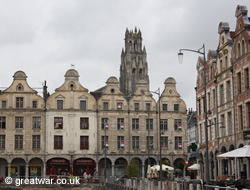
Arras is the capital of the modern-day Department of Pas-de-Calais. Much of the centre of the city was rebuilt in the medieval style. It is a busy commercial and cultural centre in the region, offering visitors a variety of accommodation, restaurants and museums.

Lille

German troops parading in Lille, occupied by Imperial German forces from October 1914 to October 1918.GWPDA
German troops parading in Lille.

Lille was occupied by the German Army from 12th October 1914 to 17th October 1918.

Lille is also known by its Dutch name of Rijsel. It is the modern-day capital of the region of Nord-Pas-de-Calais.

Front Line Villages

Many villages in this sector of the Western Front found themselves located in the Front Line, the names of which became associated with battles of 1914-1918, for example, Neuve-Chapelle, Loos and Fromelles.

Rear Area Towns

On both sides of the Front Lines towns in the rear areas, like St. Omer for the Allies and Douai, for the Germans were used for their facilities as rail transport hubs, for billeting troops, rest areas, headquarters and medical stations.

Mining Communities

Miners' cottages at Grenay, near Loos-en-Gohelle, with slag heaps in the background.
Miners' cottages at Grenay, near Loos-en-Gohelle.

Some towns in the industrial mining area centred around Lens, were characterized by numerous built-up conurbations consisting of rows and rows of small houses for the mine workers. Often they were prefixed with the name “Cité”, for example, Cité-St. Auguste, Cité-St. Laurent.

Towns and Villages on the French Flanders & Artois Battlefields

Museums

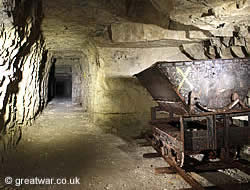
Tunnel and mining truck in the Wellington Quarry (La Carrière Wellington) museum in Arras.
Tunnel and mining truck in the Wellington Quarry (La Carriere Wellington) museum in Arras.

There are several private and public museums or visitor centres with unique collections and experiences for visitors to the French Flanders and Artois battlefields.

Museums on the French Flanders and Artois Battlefields

Cemeteries

Givenchy Road Canadian Cemetery, Neuville-St.-Vaast.
Givenchy Road Canadian Cemetery, Neuville-St.-Vaast

The battlefield area of French Flanders contains the resting place of many thousands of Allied and Imperial German troops. The military cemeteries for the British and Commonwealth casualties number over 300 and range in size from small battlefield cemeteries to larger concentration or collecting cemeteries created after the First World War. This area includes several French military cemeteries, one of which is the largest French military cemetery in the world at Ablain St. Nazaire (Notre Dame de Lorette). The largest German military cemetery for First World War casualties in France called Neuville-Saint-Vaast “Maison Blanche” contains the remains of 44,833 German soldiers.

Cemeteries in French Flanders and Artois

Monuments and Memorials

The twin pylons of the Canadian national memorial at Vimy Ridge, commemorating 60,000 Canadian servicemen who fell in France during the First World War, and which commemorates the names of over 11,000 of them who have no known grave.
Canadian National Vimy Memorial, Vimy Ridge.

In addition to numerous memorials to individual military units, this battlefield area has several national memorials dedicated to thousands of servicemen who died in this area and who have no known grave.

Monuments and Memorials in French Flanders and Artois

Memorials to the Missing

Arras Memorial to the Missing (British)

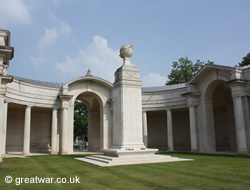
Arras Flying Services Memorial (British)

Canadian National Vimy Memorial

Loos Memorial to the Missing

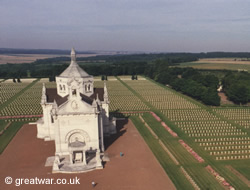
Notre Dame de Lorette Ossuaries and Lantern Tower (French)

Battlefield Remains

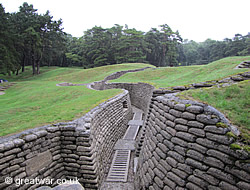
Preserved trenches at the Vimy Memorial Park.

There are three main sites where battlefield remains can be visited. These include trenches, tunnels and mine craters.

Battle Remains in the French Flanders and Artois Battlefields

Related Topics

The Western Front

An overview of the main WW1 battle areas of the Western Front and the type of landscape where they are found in Belgium and France:

WW1 Battlefields of the Western Front

Battles of the Western Front 1914-1918

Visiting the WW1 Western Front Battlefields

Advice and information for travellers wishing to visit the battlefields in Belgium and France:

Visiting the WW1 Western Front Battlefields

Acknowledgements

(GWPDA) Photographs with grateful thanks to the Great War Primary Document Archive: Photos of the Great War.