Battles of the Somme
The Great War Arrives in Picardy, September 1914
|
By 22nd September 1914, following the First Battle of the Marne (6th – 12th September 1914) and the First Battle of the Aisne (12th – 21st September 1914), the French and German armies began fighting a series of battles side-stepping one another through northern France in an attempt to outflank the other. These outflanking manoeuvres would take them in a north-westerly direction from the Aisne region towards the French coast. This period of fighting became known as “The Race to the Sea”. When the fighting of the First World War arrived in the Somme and Picardy region in September 1914 the British Expeditionary Force was not involved in the first battles of the Somme at that time.
- Battles of the Somme, 1914
- The Somme Battlefield, 1915
- Battles of the Somme, 1916
- Battles of the Somme, 1918
Battles of the Somme, 1914
- First Battle of Picardy
22-Sep-1914—
26-Sep-1914
German soldiers in Thiepval village, incorporated in the new defensive Front Line on the Somme battlefield. From October 1914 the cellars were used for shelter, billets and headquarters. Trenches were dug in and around the château and the village. This trench, seen on the left side of the road, was called “Schwabengraben”. (2 119)
By 23rd September the German Sixth Army had arrived at St. Quentin and Péronne on the right wing of the German forces in the field, having been moved by rail from its fighting front in Lorraine a few days before.
At this time the French Tenth Army moved to the area of Amiens. From 25th September the French Army started to push in an easterly direction, engaging the Germans, trying to push them eastwards and turn the German right flank.
On the right wing of the German Sixth Army two Bavarian Corps were in action south of the Somme river at Foucaucourt-en-Santerre on 24th September. The objective was to try to push the French Army in a westerly direction towards Amiens and to swing around the French left flank. The Bavarian Corps moved further north to the area north of Péronne and east of Albert on 25th September, capturing the ground immediately north of the Somme river between the villages of Fricourt, Mametz, Montauban and Maricourt.
- First Battle of Albert
25-Sep-1914—
29-Sep-1914
While the Bavarians of the German Sixth Army were fighting the French east of Albert, the XIV (Württemberger) Reserve Corps, consisting of two divisions, was on its way from the German Seventh Army in Alsace, to move into position on the right flank of the two Bavarian Corps. The XIV Reserve Corps, consisting of two divisions and approximately 24,000 men, travelled 250 miles from Alsace by rail to Cambrai. There the two divisions detrained and marched west along the road from Cambrai to Bapaume.
On 27th September 1914 the German XIV (Württemberger) Reserve Corps advanced from Bapaume down both sides of the Roman road from Bapaume to Albert. They chased away the French Territorial units in the direction of Albert. The French put up a stubborn fight to protect Albert.
After a number of fierce battles lasting into October and November, in which the Bavarians of the German Sixth Army suffered heavy casualties, the German troops were ordered to hold their positions. In mid October the German Second Army was moved into the St. Quentin Somme battle sector and the German Sixth Army moved further north to cover the ground north of Arras in what was to become the Lille – Artois battle sector.
The German Army “Digs In”
Disappointed at having to stop the advance, the divisions north of the Somme river selected good positions on high ground on which to set up a line of defence with commanding views over the enemy's lines.
The defensive line north of the Somme river initially consisted of short trench sections and fox-holes, incorporating villages and hamlets in or behind the line, including Gommecourt, Serre, Beaumont Hamel, Thiepval, La Boisselle, Fricourt, Mametz and Montauban.
The Somme Battlefield, 1915
|
During 1915 the German Second Army carried out an intensive programme of construction on its Front Line and Second Line from its northern right flank at Monchy-au-Bois, south across the Ancre river valley and over the gently rolling chalk hills to the Somme river.
From August 1915 the British Third Army, commanded by General Sir Edmund Allenby, began to take over a sector of the Front Line north of the river Somme from the French Army. In December 1915 the new British front stretched from Ransart to Curlu on the Somme river. At this time the British Third Army was sandwiched between the French Tenth Army holding 20 miles of Front Line in the Arras sector and the French Sixth Army holding the Front Line south of the Somme river.
The Somme sector remained quiet over the winter of 1915/1916. The German troops busied themselves securing their defences. On both sides of the wire the troops carried on the daily routines of trench life and training.
Battles of the Somme, 1916
- Battles of the Somme
01-Jul-1916 —
18-Nov-1916
- Battle of Albert
01-Jul-1916—
13-Jul-1916
- Subsidiary Attack: Gommecourt Salient
01-Jul-1916
- Battle of Albert (continued)
02-Jul-1916—
13-Jul-1916
Tactical Incidents in the Battle of Albert
In the days from 1st July until 13th July the following ground was captured by British forces:
- Capture of Montauban on 1st July by 30th Division
- Capture of Mametz by 7th Division
- Capture of Fricourt by 17th Division
- Capture of Contalmaison by 23rd Division
- Capture of La Boisselle by 19th Division
Battles continued in this sector into the following weeks as the British tried to break the German defence. The names of villages and woods on the Somme battlefields have become synonymous with the desperate fighting and tragic loss of both the British and German Armies during the four and a half months of these battles: Gommecourt, Serre, Beaumont Hamel, Thiepval, Ovillers, La Boisselle, Courcelette, Fricourt, Contalmaison, Mametz, Montauban, Bazentin, Longueval, Delville Wood, Martinpuich, High Wood, Flers.
|
The proposal for an offensive on the Somme battlefront was proposed by the Commander-in-Chief of the French Armies, General Joseph Joffre, as the year of 1915 turned into 1916. Originally intended as a combined Franco-British operation on both sides of the Somme river, the French reduced their participation to a supporting role in the operation as a result of the large-scale German attack on the Verdun front from February 1916.
The British Fourth Army was formed in March 1916 and it took over the Somme battlefront from the British Third Army between Fonquevillers and Maricourt on the Somme river. The British operational plan for an offensive between Serre on the left wing and Maricourt on the right wing developed during April, May and June 1916. It was approved that the Third Army would commit two infantry divisions for a subsidiary attack at the same time as the main offensive against the heavily fortified German front at Gommecourt on the Fourth Army's northern left flank. On the other side of the wire opposite the British line north of the Somme river five German frontline divisions were in position to defend their Front Line, with four in reserve and/or at rest.
Preparations for the Offensive
|
From the early spring of 1916 into June the Somme battlefield sector behind the British and French lines was the scene of a huge build-up of troops, artillery and equipment in preparation for the large-scale offensive against the German defensive line.
Preparatory Bombardment
|
The artillery programme was for a bombardment, the intensity of which had not been witnessed before on this battlefront. The bombardment was to wear down the morale and nerves of the German defenders, cut through the German barbed wire defences and smash their Front Line trenches and rear supply routes. As a result of the postponement of the infantry attack to 1st July, there were two additional days of preparatory artillery bombardment, making it seven days in total.
The Troops Prepare for the Battle
|
Final preparations of training and planning were made by the British infantry during the days of the preparatory bombardment. Raids and patrols were carried out. Reports about the wire were varied and at times conflicting. Generally it appeared from these reports that the wire had been better cut on the right of the Fourth Army front, south of the Albert-Bapaume road, than on the left front. During the night of 30 June into the early hours of 1 July thousands of British troops made their way on a moonless, but clear night along pre-prepared routes into their assembly positions in the forward lines, to get into position ready for Zero Hour at 07.30 on 1st July.
Mines Exploded under German Positions
|
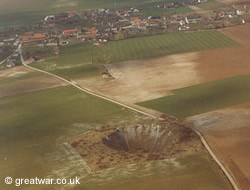
In order to knock out a number of key defensive positions in the German Front Line the British exploded eight large mines just before Zero Hour of 07.30 hours.
Lochnagar Mine Crater Memorial, La Boisselle
British Infantry Advance
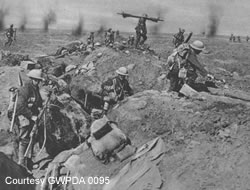
In some parts of the British line troops had crawled out in front of the Front Line trench before Zero Hour. At Zero Hour 07.30 whistles blew all along the British Front Line north of the Somme river. Thousands of British troops clambered over the trench parapet into No Man's Land, making for the German Front Line.
|
The British Official History records the moment:
“Under a cloudless blue sky which gave full promise of the hot mid-summer day which was ahead, wave after wave of British infantry rose and, with bayontets glistening, moved forward into a blanket of smoke and mist as the barrage lifted from the enemy's front trench. Almost simultaneously the German gunners ceased their counter-battery work and concentrated their fire upon the assault.” (10)
The tragedy of the day unfolded as thousands of British troops were cut down and wounded or killed by German machine gun and rifle fire. Many never even reached the German wire on the other side of No Man's Land.
At the end of the first day of the battle the Germans had successfully defended their positions more or less in tact north and south of the Albert—Bapaume road from between the villages of Gommecourt and Fricourt. However, to the east of Mametz village the British 18th and 30th Divisions of XIII Corps did make a successful breakthrough beyond the German Front Line, reaching their objective by the end of the day.
Heavy British Casualties
|
1st July was a tragic day for the British Army. There were some 60,000 casualties by the end of that day, 20,000 of whom were fatalities. Although the German regiments record relatively few casualties defending their line in the northern part of the battlefield two of their regiments in the south sector, where the British had successfully made a breakthrough, were decimated, each of them losing several hundred men as wounded, killed and taken prisoner.
- Battle of Bazentin
14-Jul-1916 —
17-Jul-1916
-
- Subsidiary action: Attack at Fromelles (on Aubers Ridge, Artois)
19-Jul-1916
- Subsequent action:
Attacks at High Wood
20-Jul-1916 —
25-Jul-1916
- Subsidiary action: Attack at Fromelles (on Aubers Ridge, Artois)
- Battle of Delville Wood
15-Jul-1916 —
03-Sep-1916
- Battle of Pozières
23-Jul-1916 —
03-Sep-1916
- Battle of Guillemont
03-Sep-1916—
06-Sep-1916
- Battle of Ginchy
09-Sep-1916
- Battle of Flers-Courcelette
15-Sep-1916—
22-Sep-1916
- Battle of Morval
25-Sep-1916—
28-Sep-1916
- Battle of Thiepval
26-Sep-1916—
28-Sep-1916
- Battle of Le Transloy
01-Oct-1916 —
18-Oct-1916
- Battle of the Ancre Heights
01-Oct-1916—
11-Nov-1916
- Battle of the Ancre, 1916
13-Nov-1916—
18-Nov-1916
The Battle of the Somme finally drew to a close as the winter weather worsened. It officially ended on 18th November 1916.
Battles of the Somme, 1918
- First Battles of the Somme, 1918 (Second Battle of Picardy)
21-Mar-1918—
05-Apr-1918
Operation Michael
On 21st March 1918 the German Army launched a large-scale offensive against the Allied front on the Somme battlefield. This offensive was codenamed Operation Michael, and was the first of several attacks to be made against the Allies on the northern part of the Western Front in the spring of 1918.
- Battle of St. Quentin
21-Mar-1918—
23-Mar-1918
With 72 German divisions in positions ready to attack in three waves, thousands of infantrymen from three German Armies (17th, 2nd and 18th) left the German Front Line after a five hour artillery bombardment by over 6,600 artillery pieces. Some 3.2 million shells were destined to land on the British-held front during that first day of the attack. To the German's advantage there was fog in the Somme battlefield sector, enabling the infantry to appear in the British forward positions without being seen to leave the German trenches.
The southern part of the British front held by Fifth Army was successfully broken by the German Eighteenth Army and the left wing of Second Army. Their troops advanced through the British Battle Zone in the forward area of the Front Line. In a change to the original plan, General Ludendorff decided to reinforce the sector of the attack on Operation Michael's left wing which was reported to be making good progress.
- First Battle of Bapaume
24-Mar-1918—
25-Mar-1918
- Battle of Noyon
25-Mar-1918
- Battle of Rosières
26-Mar-1918—
27-Mar-1918
- Battle of the Avre
4-Apr-1918
- Battle of the Ancre
5-Apr-1918
Long Range Gun Fires on Paris
On 24th March the long range, 256 ton German gun called “Kaiser Wilhelmgeschütz” fired its first shells from the forest of Coucy. With a range of 75-80 miles the gun reached Paris. There were three of these huge railway mounted guns in the forest; the breech blew off when the second gun was fired. The third gun began firing towards Paris on 29th March.
Difficulties of Supply
The German advance by the three armies continued during the few days after 21st March, but gradually the troops began to tire, having been on the move without relief for four days. Added to this, the supply of food, equipment, ammunition and horse fodder became problemmatic the further the infantry advanced ahead of their supply columns. The ground over which they were advancing was cratered with shell holes, roads were badly damaged and the villages they passed through were wrecked. Ironically, the German Army had been responsible for causing deliberate damage to this area when it made a withdrawal to the Siegfriedstellung (called the Hindenberg Line by the British) in the early months of 1917. The wilful destruction included poisoning of wells.
By 29th March the Germans had captured several key Allied-held towns on the Somme battlefield: Peronne, Ham, Noyon, Roye, Montdidier, Albert and Bapaume. The loss of the latter two was especially bitter for the British, given that they had struggled through the summer of 1916 to advance to Bapaume and many thousands of lives had been lost to capture this town. Within a few days in March of 1918 the ground was once more in German hands.
On 30th March General Ludendorff issued orders that the next phase of the German offensive, Operation Georgette in Flanders, would be carried out and artillery was to begin moving from the rear of the Michael area to Flanders for the artillery preparatory bombardment. The next day, 31st March, General Ludendorff chose to rest the troops fighting in the Somme sector for a couple of days with a view to resuming the advance of Operation Michael. However, by 4th March the French Army had begun to reinforce its positions with extra reserves to hold back the German Eighteenth Army south of the Somme river. American troops were beginning to arrive on the battlefront. The British and Australian forces put up a successful defence at the village of Villers-Bretonneux against units of the German Second Army. Strong Allied counter-attacks prevented further progress by the Germans to the town of Amiens. Some German commanders now considered that Germany's last chance to strike a decisive blow against the British had passed. The shortages of reserves, ammunition and horses made it impossible to consider launching another offensive in this sector on such a large-scale. On the evening of 5th April General Ludendorff sent a message to say that Operation Michael was terminated.
Casualties
Although the Germans had gained over 1,000 square miles of Allied-held territory in a few days, the casualties suffered by the Germans is recorded as 31,000 killed, 20,000 missing and 190,000 wounded. The German offensive resulted in 160,000 Allied casualties killed or wounded and 90,000 men taken prisoner. By the end of Operation Michael the German troops were generally dispirited and disorganized.
- Actions at Villers-Bretonneux
24-04-18
- Battle of Le Hamel
04-07-18
- Battle of Amiens
08-Aug-1918—
11-Aug-1918
The Second Battles of the Somme 1918 were fought in the summer of that year, following the German spring offensive of Operation Michael. The Allied offensive of the summer opened with the Battle of Amiens on 8th August. The French Army attacked at the same time to the south of the river Somme in the Battle of Montdidier. Ten Allied divisions were involved including Australian and Canadian forces serving with the British Fourth Army. The Allied forces surprised the Germans on the first day of 8th August and made rapid progress eastwards of several miles, taking hundreds of German prisoners on the way. The significant advance recaptured much of the ground lost by the Allies in March, earlier in the year. This battle marked the end of the stalemate of trench warfare on the Western Front, the effective combination of infantry, air support and tanks. It was the beginning of several battles from August to November 1918, which became known as the Hundred Days Offensive. The Allied success of 8th August was a black day for the German Army.
- Battle of Albert
21-Aug-1918—
22-Aug-1918
The British Third Army and the United States II Corps launched the attack to recapture Albert on 21st August. The town of Albert was retaken on 22nd and the town of Bapaume was captured on 29th August.
- Second Battle of Bapaume
21-Aug-1918—
03-Sep-1918
The success of the Battle of Amiens continued with the Second Battle of Bapaume from 21st August. The British Third Army and the United States II Corps launched the attack. The town of Albert was retaken on 22nd and the town of Bapaume was captured on 29th August.
- Battle of Mont St. Quentin
31-Aug-1918—
04-Sep-1918
During the night of 30th/31st August troops of the Australian 2nd Division crossed the marshy ground and the Somme river to make their way up the slope to the high ground of Mont St. Quentin. A German-held position on this hill overlooked the town of Péronne and provided the Germans with a good vantage point over any Allied attack in daylight. Successfully taking the summit of the hill, the Australians were pushed off it again when German reserves arrived to recapture the position. The next day, however, the Australians managed to push the Germans off the hill completely and it was finally under Allied control. The town of Péronne was captured on 1st September. The Australian units involved suffered high casualties but had achieved a great success in capturing the position, resulting in the start of a German withdrawal to the east.
Related Topics
Cemeteries on the Somme Battlefields
|
There are over 250 military cemeteries on the Somme battlefields for the many thousands of casualties who have identified graves. The cemeteries range in size from a few battlefield burials to cemeteries containing several thousand individuals.
There are also graves in these cemeteries marked as unidentified for those whose remains were discovered, but not identifiable. In the case of the French military cemeteries and burial sites there are graves and ossuaries for the remains of French soldiers. The German military cemeteries are on land granted by the French nation for the burial of German dead, but in most cases the soldiers are buried with up to four individuals in each plot and in mass graves marked as “Kameradengraben” (Comrades Grave).
Cemeteries on the Somme BattlefieldsMonuments on the Somme Battlefields
Monuments and memorials on the Somme battlefields range from monuments dedicated to the memory of thousands of troops whose identified remains are missing, to monuments commemorating a specific military unit or an individual.
Monuments on the Somme BattlefieldsThiepval Memorial to the Missing
The Thiepval Memorial to the Missing commemorates over 72,000 soldiers of the United Kingdom and South African forces who died in the Somme sector before 20th March 1918 and have no known grave. Over 90% of those commemorated died during the 1916 Battles of the Somme between July and November 1916.
Thiepval Memorial to the Missing
Lochnagar Mine Crater Memorial, La Boisselle
|
Lochnagar Mine was one of eight large mines blown by the British Army on 1st July 1916. The huge crater left by the explosion is now protected as a memorial and is one of the most visited places on the Somme battlefields.
Lochnagar Mine Crater Memorial, La Boisselle
Museums on the Somme Battlefields
Visiting the Somme Battlefields
See our page about places to visit and where to stay on or near the battlefields of the Somme:
Visiting the Somme Battlefields
Acknowledgements
(1, 2, 7) Das Württembergische Reserve-Infanterie-Regiment Nr 119 im Weltkrieg 1914-1918, von Matthäus Gerster, Chr. Belsersche Verlagsbuchhandlung, Stuttgart, 1920.
(3) An der Somme: Erinnerungen der 12. Infanterie-Division an die Stellungskämpfe und Schlacht an der Somme, Oktober 1915 bis November 1916, Ferd. Dümmlers Verlagsbuchhandlung, Berlin, 1918.
(4, 5, 6, 8, 9, 11 GWPDA) Photographs with grateful thanks to the Great War Primary Document Archive: Photos of the Great War.
(10) History of the Great War, Military Operations, France and Belgium 1916, Sir Douglas Haig's Command to the 1st July: Battle of the Somme, compiled by Brigadier-General Sir James E Edmonds, CB, CMG, RE (Retired), psc. Macmillan and Co, Ltd., 1932, p. 315.
A Record of the Battles and Engagements of the British Armies in France and Flanders, 1914-1918, by Captain E A James. Originally published in 1924 by Gale & Polden Ltd, Aldershot. Republished in 1990 by The London Stamp Exchange Ltd.
History of the Great War, Military Operations, France and Belgium 1916, Sir Douglas Haig's Command to the 1st July: Battle of the Somme, compiled by Brigadier-General Sir James E Edmonds, CB, CMG, RE (Retired), psc. Macmillan and Co, Ltd., 1932.