Cemeteries on the Somme Battlefields, France
“Behind that long and lonely trenched line
To which men come and go, where brave men die,
There is a yet unmarked and unknown shrine,
A broken plot, a soldier’s cemetery...”
From A Soldier's Cemetery by Sgt. John William Streets, killed near Serre on 1st July 1916.
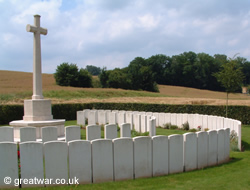
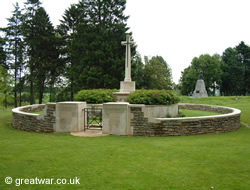
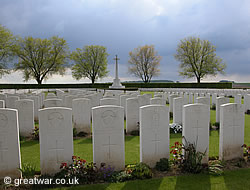
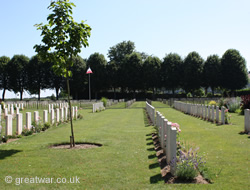
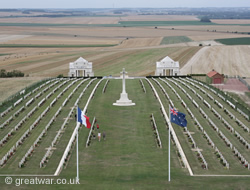
The battlefields of the Somme today contain many thousands of graves for the identified and unidentified remains of those killed in action or who died of their wounds. The land on which the British cemeteries and official memorials are situated was given by the French government for those soldiers buried or named there to remain in perpetuity.
|
Some of the British and Commonwealth cemeteries contain a small number of battlefield burials for the graves of soldiers buried close to where they fell in action. Others are large so-called ‘collecting’ or ‘concentration’ cemeteries, where the remains of identified and unknown soldiers have been brought together from smaller cemeteries or individual plots. In some cases where military or medical units were based near to a village behind the Front Lines, military burials were made in the local village civilian cemetery, known as the “communal cemetery”. Often the number of burials had to continue outside the civilian cemetery boundary, and these became known as a “communal cemetery extension”.
The listing below gives the name and location of British, French and German military cemeteries on the old 1916 and 1918 battlefields of the Somme.
-
Abbeville Communal Cemetery & Extension
50.121482455425834
1.832871437072754
For much of the First World War, Abbeville was headquarters of the Commonwealth lines of communication and No.3 BRCS, No.5 and No.2 Stationary Hospitals were stationed there variously from October 1914 to January 1920. The communal cemetery was used for burials from November 1914 to September 1916, the earliest being made among the French military graves. The extension was begun in September 1916.
Website: www.cwgc.org
-
Acheux British Cemetery
50.071267532440054
2.52410888671875
The VIII Corps Collection Station was placed at Acheux in readiness for the Battle of the Somme in 1916 and the graves of July, August and September 1916, in Row A and part of Row B, are the earliest in the cemetery. A few graves in Row B mark the period of eighteen months during which the field ambulances had moved eastwards and the cemetery was little used. The remaining graves cover the period April to August 1918, when the German offensives brought the Allied front line within 8 kilometres of Acheux. There are now 180 First World War burials in the cemetery. The cemetery was designed by N A Rew.
Website: www.cwgc.org
-
Achiet-le-Grand Communal Cemetery & Extension
50.13631042489358
2.7749785780906677
Website: www.cwgc.org
-
Achiet-le-Petit German Military Cemetery
50.122633972976935
2.757219672203064
The cemetery was started in the autumn of 1914. Burials continued here until March 1917 when the German forces withdrew from this area, but began again from March until August 1918 when the German Army retook the territory. After the war, in 1924, the French authorities brought the remains of over 300 German servicemen to this cemetery from graves and small burial plots in the surrounding area. Most of the casualties buried in the cemetery were killed during the Battle of the Somme from 1 July 1916.For further information about the German graves in this cemetery visit the website of the Volksbund Deutsche Kriegsgräberfürsorge war graves agency:
Website: www.volksbund.de
-
Adanac Military Cemetery, Miraumont-Pys
50.07417270458955
2.744406759738922
Website: www.cwgc.org
-
Adelaide Cemetery, Villers-Bretonneux
49.87112876985874
2.4981746077537537
Website: www.cwgc.org
-
A.I.F. Burial Ground, Grass Lane, Flers
50.06017544145437
2.830553948879242
Website: www.cwgc.org
-
Albert Communal Cemetery Extension
49.99838032638984
2.654649317264557
Website: www.cwgc.org
-
Albert French Military Cemetery
49.996842361059265
2.6630553603172302
There are 3,175 French soldiers buried or commemorated in the cemetery. There are also the graves of one Commonwealth casualty, that of a Chinese Labour Corps man, Wing Yuk Shan. He died on 5th December 1918. -
Allonville Communal Cemetery
49.940725201617816
2.3693333566188812
Website: www.cwgc.org
-
Amiens French Military Cemetery “Saint-Acheul”
49.91163268418755
2.328752875328064
The cemetery contains the graves of 2,739 French soldiers. There are 10 Belgian graves, 12 British graves and one Russian grave The cemetery also contains a monument to the dead of 1914-1918. The cemetery was started during the First World War. -
Amiens French Military Cemetery “Saint-Pierre”
49.91163268418755
2.328752875328064
The cemetery contains the graves of 1,347 French soldiers and 25 Belgian graves. The cemetery was started during the First World War. -
Ancre British Cemetery, Beaumont-Hamel, Somme, France
50.06793085466318
2.667574882507324
Ancre British Cemetery is about 2 kilometres south of the village of Beaumont-Hamel, on the D50 between Albert and Achiet le Grand.
The village of Beaumont-Hamel was attacked on 1 July 1916 by the 29th Division, with the 4th on its left and the 36th (Ulster) on its right, but without success. On 3 September a further attack was delivered between Hamel and Beaumont-Hamel and on 13 and 14 November, the 51st (Highland), 63rd (Royal Naval), 39th and 19th (Western) Divisions finally succeeded in capturing Beaumont-Hamel, Beaucourt-sur-Ancre and St. Pierre-Divion. Following the German withdrawal to the Hindenburg Line in the spring of 1917, V Corps cleared this battlefield and created a number of cemeteries, of which Ancre British Cemetery (then called Ancre River No 1 British Cemetery, V Corps Cemetery No. 26) was one.
The original burials were almost all of the 63rd and 36th Divisions, but after the Armistice the cemetery was greatly enlarged when many more graves from the same battlefields and from smaller burial grounds in the area were brought into it. The majority of those buried in the cemetery died on 1 July, 3 September or 13 November 1916. There are now 2,540 Commonwealth casualties of the First World War buried or commemorated in the cemetery. 1,335 of the graves are unidentified, but special memorials commemorate 43 casualties known or believed to be buried among them.
There are also special memorials to 16 casualties known to have been buried in other cemeteries, whose graves were destroyed by shell fire. The cemetery was designed by Sir Reginald Blomfield.
Website: www.cwgc.org
-
Andechy German Military Cemetery
49.715293464587006
2.701542377471924
The cemetery was created after the First World War when the French authorities brought graves of German soldiers to this place from the surrounding area. Most of the casualties were killed in March 1918 and the battles that followed. There are 2,251 German soldiers buried in the cemetery.For further information about the German graves in this cemetery visit the website of the Volksbund Deutsche Kriegsgräberfürsorge war graves agency:
Website: www.volksbund.de
-
Assevillers New British Cemetery
49.89669304697583
2.842564880847931
Website: www.cwgc.org
-
Aubigny British Cemetery
49.899035876891574
2.4841707944869995
Website: www.cwgc.org
-
Auchonvillers Military Cemetery
50.08076876816718
2.627151310443878
Website: www.cwgc.org
-
Auchonvillers Communal Cemetery
50.078489855066394
2.6332801580429077
Website: www.cwgc.org
-
Authuile Military Cemetery
50.04058963635772
2.6656973361968994
Website: www.cwgc.org
-
Aveluy Communal Cemetery Extension
50.02461815675677
2.6567065715789795
Website: www.cwgc.org
-
Aveluy Wood Cemetery (Lancashire Dump), Mesnil-Martinsart
50.04509928217237
2.660536766052246
Website: www.cwgc.org
-
Ayette British Cemetery
50.175729129237986
2.732055187225342
Website: www.cwgc.org
-
Ayette Indian & Chinese Cemetery
50.171303921041684
2.7327096462249756
Website: www.cwgc.org
-
Bancourt British Cemetery and Bancourt Communal Cemetery
50.10239147743423
2.896624803543091
Website: www.cwgc.org
-
Bapaume Australian Cemetery
50.10144271589486
2.854546308517456
Website: www.cwgc.org
-
Bapaume Post Miltary Cemetery, Albert
50.01153722943645
2.6738405227661133
Website: www.cwgc.org
-
Bavelincourt Communal Cemetery
49.987020292306475
2.4605190753936768
Website: www.cwgc.org
-
Bazentin-le-Petit Communal Cemetery & Extension
50.031837854497084
2.7673906087875366
Website: www.cwgc.org
-
Bazentin-le-Petit Military Cemetery
50.03255114996715
2.7598750591278076
Website: www.cwgc.org
-
Beacon Cemetery, Sailly-Laurette
49.936691212480866
2.6164519786834717
Website: www.cwgc.org
-
Beacourt British Cemetery, Beaucourt-en-Santerre
49.79232539095919
2.590928077697754
Website: www.cwgc.org
-
Beaulencourt British Cemetery, Ligny-Thilloy
50.07961463731083
2.853473424911499
Website: www.cwgc.org
-
Beaumont-Hamel British Cemetery
50.085918988120405
2.6498830318450928
Beaumont-Hamel was attacked and reached on 1st July 1916, but it could not be held. It was attacked again, and this time taken, on 13th November 1916 and the British cemetery (originally titled as 'V Corps Cemetery No.23') was made by units taking part in that and subsequent operations until February 1917. It was increased after the Armistice when graves were brought in from the surrounding battlefields. The cemetery now contains 179 Commonwealth burials and commemorations of the First World War. 82 of the burials are unidentified but there are special memorials to two casualties known to be buried among them.
The cemetery was designed by W H Cowlishaw.
Website: www.cwgc.org
-
Beauval Communal Cemetery
50.11267249808124
2.3282593488693237
Website: www.cwgc.org
-
Bécourt Military Cemetery, Bécordel-Bécourt
50.003944637181505
2.683582305908203
Website: www.cwgc.org
-
Berles-au-Bois Churchyard Extension
50.20143395392593
2.6258450746536255
Website: www.cwgc.org
-
Berles New Military Cemetery, Berles-au-Bois
50.20139274935376
2.6241177320480347
Website: www.cwgc.org
-
Berles Position Military Cemetery, Berles-au-Bois
50.190595926001336
2.644035816192627
Website: www.cwgc.org
-
Bernafay Wood British Cemetery, Montauban
50.01188104431589
2.7929306030273438
Website: www.cwgc.org
-
Bertincourt Château British Cemetery
50.09031010999169
2.9900890588760376
Website: www.cwgc.org
-
Bertrancourt Military Cemetery
50.09058888687411
2.5510597229003906
Website: www.cwgc.org
-
Béthencourt-sur-Somme German Military Cemetery
49.797727453352906
2.962092161178589
For further information about the German graves in this cemetery visit the website of the Volksbund Deutsche Kriegsgräberfürsorge war graves agency:
Website: www.volksbund.de
-
Biaches French Military Cemetery
49.92733849781089
2.887558937072754
-
Bienvillers Military Cemetery
50.16985304154309
2.6073110103607178
Website: www.cwgc.org
-
Blangy-Tronville Communal Cemetery
49.875225633626926
2.419036030769348
Website: www.cwgc.org
-
Blighty Valley Cemetery, Authuile Wood, Aveluy
50.03334621498946
2.669076919555664
Authuile and Aveluy are villages 4 kilometres north-east of the town of Albert. The Cemetery is situated in a valley half way between these two villages on the D151 (Cemetery is signposted on exit of Aveluy direction Authuile). The Cemetery is on the eastern side of the road D151 and access is 500 metres by grass pathway (unfit for cars).
The Cemetery was begun early in July, 1916, and used until the following November by the troops taking part in the fighting on that front. It then contained the graves of 212 soldiers, and comprised the whole of the present Plot 1 except 21 graves; and it was not used again until after the Armistice, when 784 graves were brought in from the battlefields and small cemeteries to the East. The majority of the officers and men thus reburied fell on the 1st July, 1916. There are now just over 1,000, 1914-18 war casualties commemorated in this site. Of these, over half are unidentified, and special memorials are erected to 24 soldiers from the United Kingdom known or believed to be buried among them. There are five other special headstones commemorating soldiers from the United Kingdom, buried by the enemy in Becourt German Cemetery in the spring of 1918, whose graves could not be found on exhumation. The 70th Infantry Brigade erected a wooden memorial in the cemetery to their dead of the 1st July, 1916. The cemetery covers an area of 4,236 square metres. The only main graveyard concentrated into Blighty Valley Cemetery was:-
QUARRY POST CEMETERY, AUTHUILE WOOD, which was on the South-Eastern edge of the Wood, in the commune of Ovillers-La Boisselle. It was used from July, 1916 to February, 1917, chiefly by units of the 12th (Eastern) Division, and it contained the graves of 50 soldiers from the United Kingdom.
Website: www.cwgc.org
-
Bonnay Communal Cemetery Extension
49.93716860618527
2.504587769508362
Website: www.cwgc.org
-
Boves West Communal Cemetery Extension
49.844494603944725
2.379949539899826
Website: www.cwgc.org
-
Bouchoir New British Cemetery
49.740400260731555
2.688549757003784
Website: www.cwgc.org
-
Bouzincourt Communal Cemetery & Extension
50.02893540226476
2.6081693172454834
Website: www.cwgc.org
-
Bouzincourt Ridge Cemetery, Albert
50.02186439187808
2.6370245218276978
Website: www.cwgc.org
-
Bray Hill British Cemetery, Bray-sur-Somme
49.95913993976905
2.716914117336273
Website: www.cwgc.org
-
Bray Military Cemetery, Bray-sur-Somme
49.947503918042855
2.7198833227157593
Website: www.cwgc.org
-
Bray-sur-Somme Communal Cemetery
49.942675325300456
2.7171072363853455
There are three British First World War casualties buried in the communal cemetery.Website: www.cwgc.org
-
Bray-sur-Somme German Military Cemetery
49.94044509358199
2.7126359939575195
-
Bray-sur-Somme French Military Cemetery, Bray-sur-Somme
49.943593625999576
2.7170106768608093
There are 1,043 French soldiers buried in the cemetery. This figure includes 102 of whom are laid to rest in the ossuary. One British soldier is buried in the cemetery in grave number 582. He is Corporal Albert E King of the Royal Garrison Artillery. He died on 14th October 1916. -
Bray Vale British Cemetery, Bray-sur-Somme
49.955084713411644
2.7077677845954895
Website: www.cwgc.org
-
Brie British Cemetery
49.86621553233407
2.9324564337730408
Website: www.cwgc.org
-
Bronfay Farm Military Cemetery, Bray-sur-Somme
49.967521038865605
2.7433043718338013
Website: www.cwgc.org
-
Bucquoy Communal Cemetery & Extension
50.14131302835621
2.7142319083213806
Website: www.cwgc.org
-
Bulls Road Cemetery, Flers
50.049132225574574
2.828276753425598
Website: www.cwgc.org
-
2nd Canadian Cemetery (Sunken Road), Contalmaison
50.03211352550005
2.7300676703453064
Website: www.cwgc.org
-
Carnoy Military Cemetery
49.98209470777965
2.754674255847931
Website: www.cwgc.org
-
Caix British Cemetery
49.81091149543708
2.6505374908447266
Website: www.cwgc.org
-
Caix German Military Cemetery
49.812081544173225
2.6506125926971436
For further information about the German graves in this cemetery visit the website of the Volksbund Deutsche Kriegsgräberfürsorge war graves agency:
Website: www.volksbund.de
-
Caterpillar Valley Cemetery, Longueval
50.02564770491413
2.791696786880493
Longueval is a village approximately 13 kilometres east of Albert and 10 kilometres south of Bapaume. Caterpillar Valley Cemetery lies a short distance west of Longueval on the south side of the road to Contalmaison.
Caterpillar Valley was the name given by the army to the long valley which rises eastwards, past "Caterpillar Wood", to the high ground at Guillemont. The ground was captured, after very fierce fighting, in the latter part of July 1916. It was lost in the German advance of March 1918 and recovered by the 38th (Welsh) Division on 28 August 1918, when a little cemetery was made (now Plot 1 of this cemetery) containing 25 graves of the 38th Division and the 6th Dragoon Guards. After the Armistice, this cemetery was hugely increased when the graves of more than 5,500 officers and men were brought in from other small cemeteries, and the battlefields of the Somme. The great majority of these soldiers died in the autumn of 1916 and almost all the rest in August or September 1918.
CATERPILLAR VALLEY CEMETERY now contains 5,569 Commonwealth burials and commemorations of the First World War. 3,796 of the burials are unidentified but there are special memorials to 32 casualties known or believed to be buried among them, and to three buried in McCormick's Post Cemetery whose graves were destroyed by shell fire.
Website: www.cwgc.org
-
Cayeux Military Cemetery, Cayeux-en-Santerre
49.814030408708895
2.5943613052368164
Website: www.cwgc.org
-
Cerisy-Gailly French Military Cemetery
49.9055316244048
2.6307883858680725
The French military cemetery contains the remains of 990 French soldiers. The cemetery was created next to the village communal cemetery by a French Tenth Army casualty clearing hospital in February 1916. Most of the casualties buried here died during the Battle of the Somme in the summer of 1916.
There is a plot at the western end of the French cemetery for Commonwealth burials. 393 Commonwealth servicemen of the First World War are buried in this plot, but only 97 of them are identified. The graves of most of these unidentified casualties were brought in from the battlefields after the Armistice. Graves were also brought in for reinterment from Buire Communal Cemetery Extension after the war.
-
Cerisy-Gailly Military Cemetery
49.90430855580759
2.632204592227936
Website: www.cwgc.org
-
Chipilly Communal Cemetery & Extension
49.91073795644031
2.6509371399879456
Website: www.cwgc.org
-
Citadel New Military Cemetery, Fricourt
49.976616644728
2.7185824513435364
Website: www.cwgc.org
-
Clery-sur-Somme French Military Cemetery, “Le Bois des Ouvrages”
49.96275311754869
2.8594493865966797
-
Combles Communal Cemetery Extension
50.01084430630777
2.8715863823890686
Website: www.cwgc.org
-
Connaught Cemetery, Thiepval
50.05887364334289
2.6805004477500916
Website: www.cwgc.org
-
Contalmaison Château Cemetery, Contalmaison
50.02437001420311
2.730427086353302
Website: www.cwgc.org
-
Contay British Cemetery
49.9989449243505
2.4833768606185913
Website: www.cwgc.org
-
Corbie Communal Cemetery & Extension
49.91573992790342
2.520292103290558
Website: www.cwgc.org
-
Couin British Cemetery
50.13932580246035
2.533526122570038
Website: www.cwgc.org
-
Couin New British Cemetery
50.13961460858233
2.533075511455536
Website: www.cwgc.org
-
Courcelette British Cemetery
50.05552944447951
2.7342894673347473
Website: www.cwgc.org
-
Courcelles-au-Bois Communal Cemetery Extension
50.105733326457994
2.585287392139435
Website: www.cwgc.org
-
Crucifix Corner Cemetery, Villers-Bretonneux
49.85347543774379
2.523186206817627
Website: www.cwgc.org
-
Dantzig Alley British Cemetery, Mametz
49.99968100669584
2.7439963817596436
The village of Mametz was carried by the 7th Division on 1 July 1916, the first day of the Battle of the Somme, after very hard fighting at Dantzig Alley (a German trench) and other points. The cemetery was begun later in the same month and was used by field ambulances and fighting units until the following November.
The ground was lost during the great German advance in March 1918 but regained in August, and a few graves were added to the cemetery in August and September 1918. At the Armistice, the cemetery consisted of 183 graves, now in Plot I, but it was then very greatly increased by graves (almost all of 1916) brought in from the battlefields north and east of Mametz and from certain smaller burial grounds, including:-
- AEROPLANE CEMETERY, FRICOURT, on the old German front line to the south of Fricourt village. It contained the graves of 24 N.C.Os. and men of the 20th Manchesters who died on 1 July 1916.
- BOTTOM WOOD CEMETERY, FRICOURT, on the south edge of a small wood between Mametz and Fricourt Woods. This was a field ambulance station for some months from July 1916, and the cemetery contained 104 graves.
- BULGAR ALLEY CEMETERY, MAMETZ, 230 metres east of the village, named from a trench. It contained the graves of 24 soldiers who died on 1 July 1916, and all but one of whom belonged to the 22nd Manchesters.
- HARE LANE CEMETERY, FRICOURT, at the north-west corner of the village, named from a trench. It contained the graves of 54 soldiers who died on 1 and 2 July 1916, and of whom 49 belonged to the 10th West Yorks.
- MAMETZ GERMAN CEMETERY, in which 12 soldiers were buried by their comrades in July and August 1916. This cemetery was near the crossing of the Fricourt-Maricourt and Mametz-Bray roads.
- MANSEL COPSE CEMETERY, MAMETZ, on the Fricourt-Maricourt road, near the present Devonshire Cemetery
- MANSEL COPSE WEST CEMETERY, MAMETZ, 460 metres further west. These contained the graves of 51 men of the 2nd Border Regiment, who died on 1 July 1916.
- MONTAUBAN ROAD CEMETERY, CARNOY, which contained the graves of 25 soldiers (almost all of the 18th Division) who died on 1 July 1916.
- VERNON STREET CEMETERY, CARNOY, in the valley between Carnoy and Maricourt, at a place called "Squeak Forward Position". 110 soldiers who died in July-October 1916 were buried here by the 21st Infantry Brigade and other units.
Dantzig Alley British Cemetery now contains 2,053 burials and commemorations of the First World War. 518 of the burials are unidentified but there are special memorials to 17 casualties known or believed to be buried among them. Other special memorials record the names of 71 casualties buried in other cemeteries, whose graves were destroyed by shell fire. The cemetery was designed by Sir Herbert Baker.
Website: www.cwgc.org
-
Daours Communal Cemetery Extension
49.905234497597256
2.445458471775055
Website: www.cwgc.org
-
Dartmoor Cemetery, Bécordel-Bécourt
49.991562558695485
2.687884569168091
Website: www.cwgc.org
-
Delsaux Farm Cemetery, Beugny
50.10888732812453
2.93409526348114
Website: www.cwgc.org
-
Delville Wood Cemetery, Longueval
50.02400032538701
2.8126931190490723
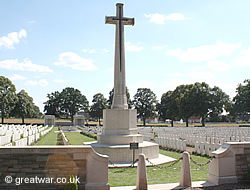
Delville Wood Cemetery was built after the Armistice. It is a large concentration cemetery with 5,523 burials, over 3,500 of which are unidentified.
Website: www.cwgc.org
-
Démuin British Cemetery
49.8262029779698
2.5352078676223755
Website: www.cwgc.org
-
Dernancourt Communal Cemetery & Extension
49.97671232071606
2.624707818031311
Website: www.cwgc.org
-
Devonshire Cemetery, Mametz
49.988383362210456
2.735724449157715
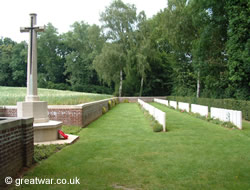
Men of the 8th and 9th Devonshire Regiment, who died on 1st July 1916, are buried in this cemetery. The poet Lt William Noel Hodgson is buried in this cemetery.
Devonshire CemeteryWebsite: www.cwgc.org
-
Dive Copse British Cemetery, Sailly-le-Sec
49.92898159277943
2.605108916759491
Website: www.cwgc.org
-
Doingt Communal Cemetery Extension
49.92337660581548
2.969401180744171
Website: www.cwgc.org
-
Domino British Cemetery, Epéhy
50.02308792392153
3.1264981627464294
Website: www.cwgc.org
-
Dompierre-Becquincourt French Military Cemetery
49.904665114643194
2.800869941711426
-
Douchy-lès-Ayette British Cemetery
50.17538465570496
2.7217018604278564
Website: www.cwgc.org
-
Doullens Communal Cemetery Extension No. 1
50.155015075684595
2.3514577746391296
Website: www.cwgc.org
-
Doullens Communal Cemetery Extension No. 2
50.156386439288866
2.350122034549713
Website: www.cwgc.org
-
Englebelmer Communal Cemetery & Extension
50.05701731456917
2.6030972599983215
Website: www.cwgc.org
-
Ennemain Communal Cemetery & Extension
49.84786513441931
2.972973883152008
Website: www.cwgc.org
-
Epéhy Communal Cemetery & Extension
50.00578325135286
3.1351348757743835
There is one burial in the communal cemetery, that of Second Lieutenant Robert Douglas Herman of 19 Squadron, Royal Flying Corps. He formerly served with the South Lancashire Regiment. He was aged 23 when he died on 22nd September 1916. This location was some miles behind the German Front Line at the timd of his death, and he was presumably buried by the Germans in this civilian cemetery.Website: www.cwgc.org
-
Epéhy Wood Farm Cemetery, Epéhy
50.00646935201697
3.1189289689064026
Website: www.cwgc.org
-
Ervillers Miltary Cemetery
50.15862040604119
2.8212949633598328
Website: www.cwgc.org
-
Eterpigny Communal Cemetery Extension (Somme)
49.89011316410928
2.9217490553855896
Website: www.cwgc.org
-
Etinhem French Military Cemetery
49.93902956788129
2.692953944206238
Website: www.cwgc.org
-
Euston Road Cemetery, Colincamps
50.10144615679509
2.6196303963661194
Colincamps and “Euston” were within the British lines before the British offensive of July 1916, and the Cemetery was used as a front line burial ground during and after the unsuccessful attack on Serre on the 1st July. After the German retreat in March 1917 it was scarcely used, and towards the end of March 1918 it passed, with Colincamps, into enemy hands; but that was the limit of the German advance. The line was held, and pushed forward, by the New Zealand Division; and the Cemetery was used again for burials in April and May 1918.
The cemetery is particularly associated with three dates and engagements; the attack on Serre on the 1st July 1916; the capture of Beaumont-Hamel on the 13th November 1916; and the German attack on the 3rd New Zealand (Rifle) Brigade trenches before Colincamps on the 5th April 1918. The whole of Plot I, except five graves in the last row, represents this original Cemetery of 501 graves.
After the Armistice, graves were brought in from the neighbouring communes. Some were in small Cemeteries and the rest were scattered over the battlefields. There are now over 1000 1914-18 war casualties commemorated in this site. Of these, nearly 200 are unidentified and special headstones are erected to 17 New Zealand soldiers, 14 British and 1 Canadian known, or believed, to be buried among these. In addition, 1 British and 1 New Zealand soldier are commemorated as buried in small Cemeteries where their graves "were destroyed in later battles." The cemetery covers an area of 3,894 square metres and is surrounded by a red brick wall with stone coping.
The following Cemeteries were concentrated into Euston Road Cemetery after the war:
- COLINCAMPS CHURCHYARD, containing 14 New Zealand graves and one British, of March and April 1918. The church has been rebuilt on a new site.
- COLINCAMPS BRITISH CEMETERY, on the Eastern outskirts of the village. It was used from March 1917 to September 1918, and it contained the graves of 96 soldiers from the United Kingdom, 23 from New Zealand, and one unidentified.
- SOUTHERN AVENUE CEMETERY, MAILLY-MAILLET, about 900 metres East of Euston Road Cemetery, close to Southern Avenue Trench. It contained 14 New Zealand graves of March and May 1918.
- WHITE CITY CEMETERY, AUCHONVILLERS, in the fields about 900 metres North-East of Auchonvillers. It was used in 1916 and 1918, and contained the graves of 106 soldiers from the United Kingdom, nine from New Zealand, and three from Canada.
- BAYENCOURT COMMUNAL CEMETERY EXTENSION, made by the 1st Essex Regiment in an orchard in April 1918, and containing eleven British graves.
- JEAN BART BRITISH CEMETERY, SAILLY-AU-BOIS, near Jean Bart Trench, between Hebuterne and Colincamps, containing the graves of fifteen men of the 1st Bn. 3rd New Zealand (Rifle) Brigade who fell on the 5th April 1918.
- JOHN COPSE BRITISH CEMETERIES, HEBUTERNE, called from one of four little woods on the 1916 front line, opposite Serre. These Cemeteries were made by the V Corps in 1917. No. 1 contained 38 and No. 2 139 graves, all of soldiers from the United, and almost all of the 12th and 13th East Yorkshire Regiment.
- LONELY BRITISH CEMETERY No. 2, COLINCAMPS, about 1.6 kilometres North-East of the Village, and close to Central Avenue Trench. It contained 17 New Zealand graves of March and May 1918.
The poet Sgt John William Streets was killed on 1st July on the first day of the Battle of the Somme. His body was not found until many months after the battle. He is known to be buried in this cemetery and is commemorated at Special Memorial A. 6.
“A Soldier's Cemetery” Poem by John William StreetsWebsite: www.cwgc.org
-
Favreuil British Cemetery
50.12242760985415
2.864864766597748
Website: www.cwgc.org
-
Five Points Cemetery, Léchelle
50.05080721786792
2.987758219242096
Website: www.cwgc.org
-
Flatiron Copse Cemetery, Mametz
50.01981614099292
2.758120894432068
Website: www.cwgc.org
-
Foncquvillers Military Cemetery
50.1489233171026
2.6262634992599487
In 1915 and 1916 the Allied front line ran between Foncquevillers and Gommecourt. The cemetery was made by French troops, and taken over by the British in the summer of 1915; the first British burials were those of the 10th Royal Fusiliers in September. It remained in use by units and Field Ambulances until March, 1917, the burials in July, 1916 (particularly in Plot I, Row L) being especially numerous. It was used again from March to August, 1918, when the German offensive brought the front line back to nearly the old position. Seventy-four graves were brought in after the Armistice from the battlefields of 1916 and 1918 to the east of the village; and the 325 French military graves were removed to La Targette French National Cemetery, near Arras. There are now over 650, 1914-18 and a small number of 1939-45 war casualties commemorated in this site. Of these, over 50 from the 1914-18 War are unidentified and special memorials are erected to two soldiers from the United Kingdom known to be buried among them. There is 1 French civilian burial, unmarked, in front of Plot 1. Row A, and there are also 4 German Foreign National burials, 2 of which are unidentified. The cemetery covers an area of 3,444 square metres and is enclosed by a brick wall. The cemeteries included in this part contain the graves of many officers and men of the Sherwood Foresters, and the village of Foncquevillers was later "adopted" by the town of Derby.
Website: www.cwgc.org
-
Forceville Communal Cemetery & Extension
50.06190331152671
2.552245259284973
Website: www.cwgc.org
-
Fouilly Communal Cemetery
49.899630205034214
2.49451607465744
Website: www.cwgc.org
-
Fouquescourt British Cemetery
49.77375894241296
2.754521369934082
Website: www.cwgc.org
-
Frankfurt Trench British Cemetery, Beaumont-Hamel
50.088375835604104
2.66655832529068
Website: www.cwgc.org
-
Franvillers Communal Cemetery & Extension
49.96472351379728
2.511129677295685
Website: www.cwgc.org
-
Frechencourt Communal Cemetery
49.96376765738842
2.437768578529358
Website: www.cwgc.org
-
Fricourt British Cemetery (Bray Road)
49.9952836554198
2.711479961872101
Website: www.cwgc.org
-
Fricourt New Military Cemetery
50.00103544223222
2.707880437374115
Website: www.cwgc.org
-
Fricourt German Military Cemetery
50.004399757631134
2.7146583795547485
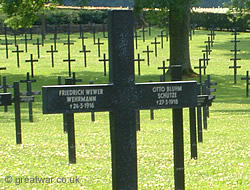
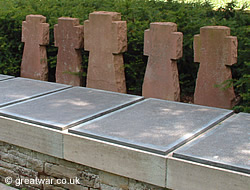
The German military cemetery at Fricourt is the resting place for 17,027 German First World War soldiers.
Fricourt German Military Cemetery
For further information about the German graves in this cemetery visit the website of the Volksbund Deutsche Kriegsgräberfürsorge war graves agency:
Website: www.volksbund.de
-
Gomiécourt South Cemetery
50.1476042199035
2.805314362049103
Website: www.cwgc.org
-
Gommecourt British Cemetery No. 2, Hébuterne
50.130052136371106
2.650175392627716
Website: www.cwgc.org
-
Gommecourt Wood New Cemetery, Foncquevillers
50.143159217887344
2.6392480731010437
Website: www.cwgc.org
-
Gordon Cemetery, Mametz
49.98761008689167
2.738640010356903
Website: www.cwgc.org
-
Gordon Dump Cemetery, Ovillers-la-Boisselle
50.02083384352918
2.7069631218910217
Website: www.cwgc.org
-
Grandcourt Road Cemetery, Grandcourt
50.07794592928012
2.713046371936798
Website: www.cwgc.org
-
Grand Ravine Cemetery, Havrincourt
50.10394418512908
3.094649612903595
Website: www.cwgc.org
-
Grévillers British Cemetery
50.10791025433424
2.8200048208236694
Website: www.cwgc.org
-
Grove Town Cemetery, Méaulte
49.96410491239622
2.6851755380630493
Meaulte is a village a little south of Albert. Leave Albert by heading south-east on the D329 in the direction of Meaulte. Go through the village of Meulte in the direction of Bray-sur-Somme. After leaving Meulte, 2.5 kilometres down the road turn right towards Etinehem (C6) heading south. The first CWGC signpost is at this turn off. Follow the C6 for 0.8 kilometres and then follow the second CWGC signpost indicating a right turn down a dirt track. Carry straight on down the dirt track for 0.4 kilometres and Grove Town British Cemetery is on the left hand side of this track.
In September 1916, the 34th and 2/2nd London Casualty Clearing Stations were established at this point, known to the troops as Grove Town, to deal with casualties from the Somme battlefields. They were moved in April 1917 and, except for a few burials in August and September 1918, the cemetery was closed. Grove Town Cemetery contains 1,392 First World War burials. The cemetery was designed by Sir Edwin Lutyens.
Website: www.cwgc.org
-
Guards’ Cemetery, Combles
50.00626156914514
2.8596264123916626
Website: www.cwgc.org
-
Guards’ Cemetery, Les Boeufs
50.03781864107129
2.8530067205429077
Website: www.cwgc.org
-
Guillemont Road Cemetery, Guillemont
50.01068641500545
2.8156864643096924
Website: www.cwgc.org
-
Ham British Cemetery, Muille-Villette
49.7340764692084
3.070954978466034
Website: www.cwgc.org
-
Hamel Military Cemetery, Beaumont-Hamel
50.06033982827703
2.66169011592865
Website: www.cwgc.org
-
Hancourt British Cemetery
49.90188305686828
3.0752572417259216
Website: www.cwgc.org
-
Hangard Communal Cemetery Extension
49.82426498597258
2.519213855266571
Website: www.cwgc.org
-
Hangard Wood British Cemetery, Hangard
49.83683978697891
2.507852017879486
Website: www.cwgc.org
-
Hannescamps New Military Cemetery
50.16643846764875
2.6369628310203552
Website: www.cwgc.org
-
Hargicourt British Cemetery
49.9592469240956
3.1679436564445496
Website: www.cwgc.org
-
Hargicourt Communal Cemetery & Extension
49.96524801899624
3.178098499774933
Website: www.cwgc.org
-
Hattencourt French Military Cemetery
49.76028755709639
2.786257266998291
-
Harponville Communal Cemetery & Extension
50.03904613085566
2.5025948882102966
Website: www.cwgc.org
-
Hawthorn Ridge Cemetery No. 1, Auchonvillers
50.08165689529614
2.6491695642471313
Website: www.cwgc.org
-
Hawthorn Ridge Cemetery No. 2, Auchonvillers
50.0780705508384
2.648059129714966
-
Heath Cemetery, Harbonnières
49.87260759915157
2.6722365617752075
Website: www.cwgc.org
-
Hébuterne Communal Cemetery
50.11968977489991
2.638239562511444
Website: www.cwgc.org
-
Hébuterne Military Cemetery
50.12596913625624
2.631348967552185
Website: www.cwgc.org
-
Hédauville Communal Cemetery Extension
50.047423645637004
2.565677762031555
Website: www.cwgc.org
-
Heilly Station Cemetery, Méricourt l’Abbé
49.9405373890308
2.5416237115859985
Website: www.cwgc.org
-
Hem Communal Cemetery, Hem-Hardival
50.16118418384925
2.298784554004669
Website: www.cwgc.org
-
Hem Farm Military Cemetery, Hem-Monacu
49.95348323634244
2.8315088152885437
Website: www.cwgc.org
-
Herbécourt British Cemetery
49.923424957226686
2.8355294466018677
Website: www.cwgc.org
-
Herbécourt Communal Cemetery
49.9231615565846
2.8344833850860596
Website: www.cwgc.org
-
Heudicourt Communal Cemetery & Extension
50.0202513499009
3.0812010169029236
Website: www.cwgc.org
-
Humbercamps Communal Cemetery & Extension
50.18821141287962
2.5757521390914917
Website: www.cwgc.org
-
Hunter’s Cemetery, Beaumont-Hamel
50.078111861766764
2.6495611667633057
-
Hillside Cemetery, Le Quesnel
49.793217927110014
2.6403290033340454
Website: www.cwgc.org
-
Hourges Orchard Cemetery, Domart-sur-la-Luce
49.813306949505744
2.5010553002357483
Website: www.cwgc.org
-
Knightsbridge Cemetery, Mesnil-Martinsart
50.067499980163824
2.6441243290901184
Website: www.cwgc.org
-
La Chapelette British and Indian Cemetery, Péronne
49.90555834270875
2.9302650690078735
Website: www.cwgc.org
-
La Neuville British Cemetery, Corbie
49.910993594633275
2.4820438027381897
Website: www.cwgc.org
-
La Neuville Communal Cemetery, Corbie
49.9166967376371
2.491179406642914
Website: www.cwgc.org
-
Le Quesnel Communal Cemetery & Extension
49.78006809338353
2.630321681499481
Website: www.cwgc.org
-
Lihons French Military Cemetery
49.828345753065555
2.7483415603637695
-
London Cemetery & Extension, High Wood, Longueval
50.03851898479635
2.781810164451599
-
Longueau British Cemetery, Amiens
49.86941386125204
2.3593488335609436
Website: www.cwgc.org
-
Longueval Road Cemetery, Longueval
50.01920697973688
2.7990514039993286
Website: www.cwgc.org
-
Lonsdale Cemetery, Authuile
50.0400030182517
2.681565284729004
Authuille is a village 5 kilometres north of the town of Albert on the D151 road to Grandcourt. The Cemetery (signposted in the centre of Authille) is 1 kilometre east of the village. Access to the cemetery, 500 metres from the road, is by a grass pathway (unsuitable for cars).
On the 1st July, 1916, the 32nd Division, which included the 1st Dorsets and the 11th (Lonsdale) Battalion of the Border Regt., attacked the German line at this point and stormed the Leipzig Salient, but were compelled to retire later in the day. In the spring of 1917 the V Corps cleared these battlefields, and made, among others, the cemeteries then known as Lonsdale No. 1 and No. 2. Lonsdale Cemetery No. 1 (the present Lonsdale Cemetery) contained originally 96 graves (now in Plot I), the great majority of which were those of officers and men of the 1st Dorsets and the 11th Borders. It was enlarged after the Armistice by the concentration of graves (almost all of 1916) from the surrounding battlefields. There are now 1,542 Commonwealth burials of the 1914-18 war, 816 of which are unidentified, commemorated in this site. Special memorials are erected to 22 soldiers from the United Kingdom, known or believed to be buried among them. There is also 1 French Foreign National burial here. The cemetery covers an area of 4,605 square metres and is enclosed by a low red brick wall. Of the smaller burial grounds now represented in this cemetery:-
- LONSDALE CEMETERY No. 2, AUTHUILE, was about 500 metres further East. It contained the graves of 38 soldiers from the United Kingdom (31 of whom belonged to the 11th Borders) and two German soldiers.
- NAB ROAD CEMETERY, OVILLERS-LA-BOISSELLE, was on the road running up Nab Valley, about 914 metres East of Lonsdale Cemetery. It contained the graves of 27 soldiers from the United Kingdom, who fell in July, September and October, 1916.
- PAISLEY AVENUE AND PAISLEY HILLSIDE CEMETERIES, AUTHUILE, were on the South side of Thiepval Wood. They contained the graves of 284 soldiers and Marines from the United Kingdom (mainly of the 49th (West Riding) Division), who fell in July, 1916-February, 1917, and two German soldiers.
Website: www.cwgc.org
-
Louvencourt Military Cemetery
50.08920186980441
2.5038447976112366
Louvencourt is a village 13 kilometres south-east of Doullens on the road to Albert (D938). The Cemetery is on the south-eastern side of the village.
From July 1915 to August 1916, field ambulances were established at Louvencourt, which was nearly 10 kilometres behind the front line on 1 July 1916. Following the 1916 Somme offensive, these medical units moved further east and the cemetery was little used until the German advances of April 1918 pushed the Allied line back to its old position. The graves of 1918, in rows D and E, relate to the climax of that fighting. There are now 151 Commonwealth burials of the First World War in this cemetery and 76 French war graves dating from 1915. The cemetery also contains three graves from the Second World War. The cemetery, one of the first three Commission cemeteries to be built after the First World War, was designed by Sir Reginald Blomfield.
Website: www.cwgc.org
-
Luke Copse British Cemetery, Puisieux
50.107842363006355
2.6593002676963806
Website: www.cwgc.org
-
Mailly-Maillet Communal Cemetery Extension
50.0859320677346
2.596316635608673
Website: www.cwgc.org
-
Mailly Wood Cemetery, Mailly-Maillet
50.0750368543417
2.5989344716072083
Website: www.cwgc.org
-
Manchester Cemetery, Riencourt-lèès-Bapaume
50.08532282732712
2.8898361325263977
Website: www.cwgc.org
-
Manicourt German Military Cemetery
49.76922732016721
2.8689658641815186
For further information about the German graves in this cemetery visit the website of the Volksbund Deutsche Kriegsgräberfürsorge war graves agency:
Website: www.volksbund.de
-
Manitoba Cemetery, Caix
49.79264052781617
2.6550275087356567
Website: www.cwgc.org
-
Marcelcave “Les Buttes” French Military Cemetery
49.860553913362054
2.560093402862549
The cemetery contains the graves of 1,610 French soldiers. The cemetery was started in 1916 during the Battle of the Somme. -
Martinpuich British Cemetery
50.04600529435456
2.7622541785240173
Website: www.cwgc.org
-
Martinsart British Cemetery, Mesnil-Martinsart
50.03796082383668
2.635042369365692
Website: www.cwgc.org
-
Maucourt French Military Cemetery
49.80003076494569
2.755551338195801
-
Maurepas French Military Cemetery
49.9882688547492
2.8532642126083374
-
Méaulte Military Cemetery
49.976981408373035
2.6608747243881226
Website: www.cwgc.org
-
Méricourt-l’Abbé Communal Cemetery Extension
49.95297931228324
2.5716832280158997
Website: www.cwgc.org
-
Mesnil Communal Cemetery Extension, Mesnil-Martinsart
50.048816234715616
2.642364799976349
Website: www.cwgc.org
-
Mesnil Ridge Cemetery, Mesnil-Martinsart
50.066652911584995
2.642616927623749
Website: www.cwgc.org
-
Mézières Communal Cemetery Extension (Somme)
49.79148386161106
2.5580307841300964
Website: www.cwgc.org
-
Millencourt Communal Cemetery Extension
50.003117134415206
2.581958770751953
Website: www.cwgc.org
-
Mill Road Cemetery, Thiepval
50.0610161960911
2.6833248138427734
Website: www.cwgc.org
-
Miraumont Communal Cemetery
50.09306683233261
2.7276214957237244
Miraumont is a village and commune about 13 kilometres north-north-east of the town of Albert on the D50 road. The Communal Cemetery is on the northern side of the village. In the centre of Miraumont take the street 'Rue du Cimetiere' which leads to the Communal Cemetery. (There is a signpost at the entrance of the Communal Cemetery, but none in the centre of Miraumont.)
Miraumont was occupied by British troops at the end of February, 1917, lost on the 25th March, 1918, and retaken by the 42nd (East Lancashire) Division on the following 24th August. It was later "adopted", with Colincamps and Courcelles, by the town of Burnley. The Communal Cemetery was largely used by German troops, and soldiers from the Commonwealth were buried in it by the enemy. There are now nearly 30, 1914-18 and a small number of 1939-45 war casualties commemorated in this site.
Website: www.cwgc.org
-
Montdidier French Military Cemetery
49.64843705201028
2.587907910346985
-
Montdidier French Military Cemetery “L'Égalité”
49.65270211594057
2.57354736328125
-
Montdidier German Military Cemetery
49.65321264822205
2.5742125511169434
For further information about the German graves in this cemetery visit the website of the Volksbund Deutsche Kriegsgräberfürsorge war graves agency:
Website: www.volksbund.de
-
Montigny Communal Cemetery & Extension
49.97791250902931
2.4384605884552
Website: www.cwgc.org
-
Moreuil Communal Cemetery Allied Extension
49.77879681439146
2.47841477394104
Website: www.cwgc.org
-
Morisel German Military Cemetery
49.76802597656418
2.4708670377731323
For further information about the German graves in this cemetery visit the website of the Volksbund Deutsche Kriegsgräberfürsorge war graves agency:
Website: www.volksbund.de
-
Morlancourt British Cemetery No. 1, Morlancourt
49.95000743370354
2.623581290245056
Website: www.cwgc.org
-
Morlancourt British Cemetery No. 2, Ville-sur-Ancre
49.952993118492124
2.6217949390411377
Website: www.cwgc.org
-
Morval British Cemetery
50.03185852987719
2.8698670864105225
Website: www.cwgc.org
-
Moislains French Military Cemetery
50.00143886907932
2.9613465070724487
-
Muille-Villette German Military Cemetery
49.73398632148601
3.0702468752861023
For further information about the German graves in this cemetery visit the website of the Volksbund Deutsche Kriegsgräberfürsorge war graves agency:
Website: www.volksbund.de
-
Munich Trench British Cemetery, Beaumont-Hamel
50.094501917149024
2.6632967591285706
Website: www.cwgc.org
-
New Munich Trench British Cemetery, Beaumont-Hamel
50.086558510247954
2.6668426394462585
Website: www.cwgc.org
-
Norfolk Cemetery, Bécordel-Bécourt, Somme
49.99861136177448
2.692953944206238
Becordel-Becourt is a village 2.5 kilometres east of Albert on the D938 (Albert-Peronne) road. Follow the C1 north to Becourt, pass under a bridge and Norfolk Cemetery will be found 700 metres along on the east side of the road.
The Cemetery was begun by the 1st Norfolks in August, 1915, and used by other units (including the 8th Norfolks) until August, 1916. After the Armistice it was nearly doubled in size by the concentration into Plot I, Row D, and Plot II of graves from the battlefields near by. There are now nearly 550, 1914-18 war casualties commemorated in this site. Of these, over 220 are unidentified. The Cemetery covers an area of 2,539 square metres and is enclosed on the road side by a brick wall.
Website: www.cwgc.org
-
Ovillers Military Cemetery, Ovillers-la-Boisselle
50.028645928514365
2.6918166875839233
Website: www.cwgc.org
-
Owl Trench Cemetery, Hébuterne
50.12942282361022
2.665485441684723
Website: www.cwgc.org
-
Peake Wood Cemetery, Fricourt
50.01785926059516
2.7225199341773987
Website: www.cwgc.org
-
Péronne Communal Cemetery & Extension (Ste Radegonde)
49.9360420967513
2.934470772743225
Website: www.cwgc.org
-
Péronne Road Cemetery, Maricourt
49.97829324663251
2.7820435166358948
Website: www.cwgc.org
-
Pigeon Ravine Cemetery, Epéhy
50.018709373594874
3.1671537458896637
Website: www.cwgc.org
-
Point 110 New Military Cemetery, Fricourt
49.98425402470876
2.719462215900421
Website: www.cwgc.org
-
Point 110 Old Military Cemetery, Fricourt
50.03406798756937
2.7190491557121277
Website: www.cwgc.org
-
Pozières British Cemetery, Ovillers-la-Boisselle
49.98627872744808
2.7151572704315186
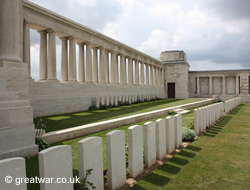
The cemetery contains the graves of 2,758 British and Commonwealth servicemen. Three of the boundary walls of the cemetery form the Pozières Memorial to the Missing for the 1918 Battles of the Somme.
Website: www.cwgc.org
-
Proyart German Military Cemetery
49.89341012932611
2.711847424507141
For further information about the German graves in this cemetery visit the website of the Volksbund Deutsche Kriegsgräberfürsorge war graves agency:
Website: www.volksbund.de
-
Puchevillers British Cemetery
50.05690090421699
2.3955237865448
In June 1916, just before the opening of the Battles of the Somme, the 3rd and 44th Casualty Clearing Stations came to Puchevillers. Plots I to V, and almost the whole of Plot VI were made by those hospitals before the end of March 1917. For the next two months the 2nd/1st South Midland Casualty Clearing Station used the cemetery. Plot VII contains for the most part the graves of men who died in the German advance in 1918, many of whom were buried by the 49th Clearing Station in March 1918, or by the 48th Labour Group in August.
Puchevillers British Cemetery contains 1,763 First World War burials. The cemetery was designed by Sir Edwin Lutyens.
Website: www.cwgc.org
-
Quarry Cemetery, Montauban
50.01424585398261
2.7817243337631226
Website: www.cwgc.org
-
Queens Cemetery, Puisieux
50.10567483635584
2.658372223377228
Website: www.cwgc.org
-
Queens Cemetery, Bucquoy
50.133528682312935
2.7023980021476746
Website: www.cwgc.org
-
Querrieu British Cemetery
49.93486607011006
2.430034428834915
Website: www.cwgc.org
-
Quesnoy Farm Military Cemetery, Bucquoy
50.16597457440575
2.6859238743782043
Website: www.cwgc.org
-
Railway Cutting Cemetery, Courcelles-le-Comte
50.14821266831333
2.783835232257843
Website: www.cwgc.org
-
Railway Hollow Cemetery, Hébuterne
50.10611179009846
2.6555022597312927
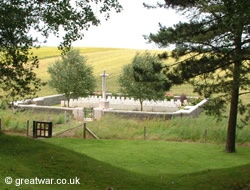
Website: www.cwgc.org
-
Rancourt Military Cemetery
49.99809411683652
2.909700572490692
Website: www.cwgc.org
-
Rancourt French Military Cemetery
49.998089748980696
2.9113179445266724
-
Rancourt German Military Cemetery
49.99681385422611
2.904837727546692
For further information about the German graves in this cemetery visit the website of the Volksbund Deutsche Kriegsgräberfürsorge war graves agency:
Website: www.volksbund.de
-
Redan Ridge Cemetery No. 1, Beaumont-Hamel
50.092798394429906
2.65207976102829
Website: www.cwgc.org
-
Redan Ridge Cemetery No. 2, Beaumont-Hamel
50.08901257155769
2.6526108384132385
Website: www.cwgc.org
-
Redan Ridge Cemetery No. 3, Beaumont-Hamel
50.091146435773894
2.653925120830536
Website: www.cwgc.org
-
Regina Trench Cemetery, Grandcourt
50.066378127630564
2.729126214981079
Website: www.cwgc.org
-
Ribemont Communal Cemetery Extension
49.964815762727596
2.560442090034485
Website: www.cwgc.org
-
Roisel Communal Cemetery & Extension
49.95015493894635
3.099297881126404
Website: www.cwgc.org
-
Ronssoy Communal Cemetery
49.98298684625616
3.161703497171402
Website: www.cwgc.org
-
Rocquigny-Equancourt Road British Cemetery, Manancourt
50.04446793430943
2.9897886514663696
Website: www.cwgc.org
-
Rosières British Cemetery, Vauvillers
49.83347667672093
2.7199530601501465
Website: www.cwgc.org
-
Rosières Communal Cemetery and Extension
49.81804558377321
2.700619697570801
Website: www.cwgc.org
-
Rossignol Wood Cemetery, Hébuterne
50.12941594582942
2.6654478907585144
Website: www.cwgc.org
-
Roye New British Cemetery
49.69136931927668
2.808809280395508
Website: www.cwgc.org
-
Roye-St. Gilles German Military Cemetery
49.682626930607846
2.784379720687866
For further information about the German graves in this cemetery visit the website of the Volksbund Deutsche Kriegsgräberfürsorge war graves agency:
Website: www.volksbund.de
-
St. Amand British Cemetery
50.167736428486606
2.5623518228530884
Website: www.cwgc.org
-
Ste. Emilie Valley Cemetery, Villers Faucon
49.97717459858336
3.120691180229187
Website: www.cwgc.org
-
St. Pierre Cemetery, Amiens
49.911547
2.327803
Website: www.cwgc.org
-
Sailly-au-Bois Military Cemetery
50.12249639766058
2.588500678539276
Website: www.cwgc.org
-
Sailly-Saillisel British Cemetery
50.019540399403375
2.909751534461975
Website: www.cwgc.org
-
Saulcourt Churchyard Extension, Guyencourt-Saulcourt
49.99636004131342
3.0847616493701935
Website: www.cwgc.org
-
Savy British Cemetery
49.825440710394815
3.1906861066818237
Website: www.cwgc.org
-
Senlis Communal Cemetery Extension
50.02847798697719
2.573517858982086
Website: www.cwgc.org
-
Serre Road Cemetery No. 1, Hébuterne
50.100175530250084
2.657039165496826
Website: www.cwgc.org
-
Serre Road Cemetery No. 2, Serre-les-Puisieux
50.09592915872886
2.6527047157287598
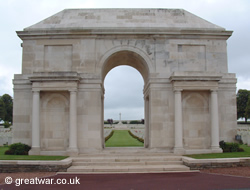
There are over 7,000 burials in this cemetery, 5,000 of whom are unidentified.
Website: www.cwgc.org
-
Serre Road Cemetery No. 3, Pusieux
50.10362763778231
2.656674385070801
Website: www.cwgc.org
-
Serre-Hébuterne French Military Cemetery
50.09931343948578
2.655773162841797
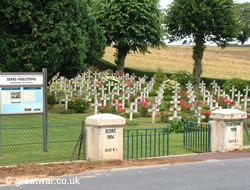
The cemetery contains the graves and remains of French soldiers killed in action during fighting against the German front line at Hébuterne from 10-13 June 1915.
Serre-Hébuterne Cemetery -
Shrine Cemetery, Bucquoy
50.14245444258285
2.6960572600364685
Website: www.cwgc.org
-
Somme American Cemetery & Memorial, Bony
49.98554060037526
3.2155796885490417
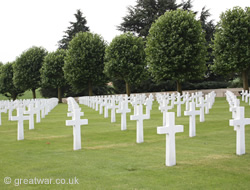
1,844 casualties of the American Expeditionary Force (AEF) are buried at the Somme American Cemetery near the village of Bony.
Somme American Cemetery & Memorial, Bony
Website: www.abmc.gov
-
Stump Road Cemetery, Grandcourt
50.06936623294118
2.708234488964081
Website: www.cwgc.org
-
Sucrerie Military Cemetery, Colincamps
50.09542672682643
2.6234418153762817
Colincamps is a village about 16 kilometres north of Albert. Sucrerie Military Cemetery is about 3 kilometres south-east of the village on the north side of the road from Mailly-Maillet to Puisieux.
The cemetery was begun by French troops in the early summer of 1915, and extended to the west by British units from July in that year until, with intervals, December, 1918. It was called at first the 10th Brigade Cemetery. Until the German retreat in March, 1917, it was rather more than a 1.6 kilometres from the front line; and from the end of March, 1918, (when the New Zealand Division was engaged in fighting at the Sucrerie) to the following August it was under fire. The 285 French and twelve German graves were removed to other cemeteries after the Armistice, and in consequence there are gaps in the lettering of the Rows. There are now 1,104 1914-18 war casualties commemorated in this site. Of these 219 casualties are unidentified. The cemetery covers an area is 6,322 square metres and it is enclosed by a low brick wall.
Website: www.cwgc.org
-
Sunken Road Cemetery, Contalmaison
50.03211352550005
2.731805741786957
Website: www.cwgc.org
-
Suzanne Communal Cemetery Extension
49.9520059645823
2.7619805932044983
Website: www.cwgc.org
-
Suzanne Military Cemetery No. 3
49.96124162058135
2.777371108531952
Website: www.cwgc.org
-
Templeux-le-Guérard British Cemetery
49.962717688801
3.1578558683395386
Website: www.cwgc.org
-
Templeux-le-Guérard Communal Cemetery Extension
49.96855365050635
3.15070778131485
Website: www.cwgc.org
-
Ten Tree Alley Cemetery, Puisieux
50.095799306956366
2.6756027340888977
Website: www.cwgc.org
-
Thiepval Anglo-French Cemetery
50.05063223515815
2.6840972900390625
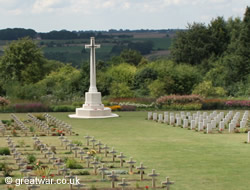
The cemetery is in the grounds of the Thiepval Memorial to the Missing. The cemetery and the memorial share an Anglo-French theme, recognizing the joint offensive by Britain and France in the Battles of the Somme 1916.
Thiepval Anglo-French CemeteryWebsite: www.cwgc.org
-
Thilloy Road Cemetery, Beaulencourt
50.07906131475134
2.8599321842193604
Website: www.cwgc.org
-
Thistle Dump Cemetery, High Wood, Longueval
50.029625537391844
2.785205841064453
Website: www.cwgc.org
-
Tincourt New British Cemetery
49.93961212505289
3.0361050367355347
Website: www.cwgc.org
-
Toronto Cemetery, Démuin
49.837154634093366
2.536468505859375
Website: www.cwgc.org
-
Two Tree Cemetery, Moyenneville
50.17721326877789
2.763935923576355
Website: www.cwgc.org
-
Unicorn Cemetery, Vendhuile
49.99691040960793
3.1815773248672485
Website: www.cwgc.org
-
Vaire-sous-Corbie Communal Cemetery
49.913024833736685
2.542811930179596
Website: www.cwgc.org
-
Varennes Military Cemetery
50.05445484294288
2.5265228748321533
Website: www.cwgc.org
-
Vermandovillers German Military Cemetery
49.85602349485785
2.782233953475952
For further information about the German graves in this cemetery visit the website of the Volksbund Deutsche Kriegsgräberfürsorge war graves agency:
Website: www.volksbund.de
-
Villers-Bretonneux Communal Cemetery
49.869638600725914
2.5208312273025513
Website: www.cwgc.org
-
Villers-Bretonneux Military Cemetery, Fouilloy
49.886488316058795
2.5098180770874023
-
Villers-Carbonnel French Military Cemetery
49.876604083888026
2.89339542388916
-
Villers-Faucon Communal Cemetery & Extension
49.980035332809685
3.09876948595047
Website: www.cwgc.org
-
Ville-sur-Ancre Communal Cemetery & Extension
49.95837033583371
2.608831822872162
Website: www.cwgc.org
-
Vrély Communal Cemetery Extension
49.800913002542764
2.687503695487976
Website: www.cwgc.org
-
Waggon Road Cemetery, Beaumont-Hamel
50.09205157850728
2.6642918586730957
Website: www.cwgc.org
-
Warlencourt British Cemetery
50.08019113250939
2.799818515777588
Website: www.cwgc.org
-
Warlincourt Halte British Cemetery, Saulty
50.19797859808814
2.518090009689331
Warlincourt and Saulty are villages on either side of the main road (N25) between Arras (22 kilometres) and Doullens (13 kilometres). Warlincourt Halte British Cemetery is situated just off the north side of the road. Large signs clearly indicate access 200 metres before the site coming from either direction.
The site of the cemetery was chosen in May 1916. It was used from June, 1916, to May, 1917, by the 20th and 43rd Casualty Clearing Stations, in February, 1917, by the 1/1st South Midland, and from April till June, 1917, by the 32nd. The whole of plots VII, VIII, IX and X were filled in April and May, 1917, the months of the Battles of Arras. From June, 1917, the cemetery was practically unused until the fighting of May and June, 1918, when Field Ambulances buried in it. After the Armistice the cemetery was increased by graves brought in from the small British cemeteries at Gaudiempre, La Herliere and Couturelle. There are now over 1,200, 1914-18 war casualties commemorated in this site. The cemetery covers an area of 5,545 square metres. The small cemeteries concentrated into Warlincourt Halte British Cemetery were the following:- GAUDIEMPRE MILITARY CEMETERY contained 33 British graves, and lay on the South-East side of the village of Guadiempre near the road to St. Amand. It was used from June, 1916, to April, 1918, chiefly by the Field Ambulances of the Divisions in the sector. COURTURELLE COMMUNAL CEMETERY EXTENSION contained 10 British graves. It was East of the village, on the South side of the road to Gombremetz; and it was used by Field Ambulances and fighting units from April, 1916, to February, 1917. LA HERLIERE MILITARY CEMETERY lay between the villages of La Herliere and Larbret. It was used from June, 1916, to January, 1917, by Field Ambulances and fighting units, and contained 13 British graves.
Website: www.cwgc.org
-
Warloy-Baillon Communal Cemetery & Extension
50.01332200633144
2.528700828552246
Warloy-Baillon is a village about 21 kilometres north-east of Amiens along the D919 to Arras. The Communal Cemetery is on the east side of the village and the extension is on the eastern side of the cemetery.
The first Commonwealth burial took place in the communal cemetery in October 1915 and the last on 1 July 1916. By that date, field ambulances had come to the village in readiness for the attack on the German front line eight kilometres away, and the extension was begun on the eastern side of the cemetery. The fighting from July to November 1916 on the northern part of the Somme front accounts for the majority of the burials in the extension, but some are from the German attack in the spring of 1918. The communal cemetery contains 46 Commonwealth burials of the First World War and 158 French war graves. The extension contains 1,331 First World War Commonwealth burials and two from the Second World War. There are also 18 German war graves in the extension.
Website: www.cwgc.org
-
Warry Copse Cemetery, Courcelles-le-Comte
50.156970717596785
2.7861231565475464
Website: www.cwgc.org
-
Warvillers Churchyard Extension
49.77897694314329
2.688925266265869
Website: www.cwgc.org
-
Wood Cemetery, Marcelcave
49.83763555045391
2.592719793319702
Website: www.cwgc.org
-
Y Ravine Cemetery, Beaumont-Hamel
50.07614266792409
2.652350664138794
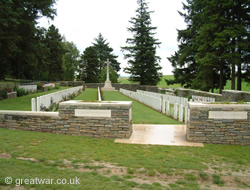
This cemetery was started in the spring of 1917 by the British V Corps and was originally called Y Ravine Cemetery No. 1.
Website: www.cwgc.org
Related Topics
War Graves on the Western Front
|
|
This article provides background to the burial of military dead from the 1914-1918 war and explains why so many casualties are recorded as “Missing”:
War Graves for WW1 Dead on The Western FrontRegisters for WW1 Military Burials and Commemorations
For more information about the organizations responsible for the maintenance of graves and memorials to servicemen and women, and for information about how to look up the location of a First World War war grave to to:
War Grave AgenciesMonuments and Memorials of the Somme Battlefields
|
There are many monuments and memorials, official and private and of varying sizes, on the Somme 1914-1918 battlefields. Several large official memorials commemorate the names of many thousands of missing casualties whose identified remains have never been found, and whose final resting place is unknown.
Monuments and Memorials of the Somme BattlefieldsCemeteries on the Ypres Salient Battlefields
For a listing and the location of British, French, Belgian and German military cemeteries on the Ypres Salient battlefields:
Cemeteries on the Ypres Salient BattlefieldsMonuments and Memorials on the Ypres Salient Battlefields
For a listing and the location of First World War memorials and monuments on the Ypres Salient battlefields:
Monuments and Memorials on the Ypres Salient BattlefieldsRelated Reading


Empires of the Dead
by David Crane
A new book published in 2013 telling the fascinating story of Fabian Ware and his vision for the building of the First World War cemeteries. Shortlisted for the Samuel Johnson prize for non-fiction.
304 pages. Published by William Collins (26 Sep 2013). ISBN-10: 0007456654. ISBN-13: 978-0007456659


The Glorious Dead
Figurative Sculpture of British First World War Memorials by Geoff Archer
For several decades there has been a 'critical dismissal' of the art connected with war memorials. This book sets out to put the record right and to return these sculptures to their rightful place in the story of British Art. Some of the works stand comparison with the best sculpture anywhere. 260 photographs illustrate the text which is followed by lists of all the sculpted war memorials in Britain, naming the sculptors and the figurative imagery involved.


The Silent Cities
An Illustrated Guide to the War Cemeteries & Memorials to the Missing in France & Flanders 1914-1918 by Sidney C. Hurst

Remembered
The History of the Commonwealth War Graves Commission by Julie Summers, Brian Harris and Ian Hislop
Features images by award winning photographer Brian Harris, never before seen photographs from the Commission's own archives and a new history of the Commission by renowned author Julie Summers.


On Fame's Eternal Camping Ground
A Study of First World War Epitaphs in the British Cemeteries of the Western Front by Trefor Jones
Based on five years' research, this book presents more than 1,500 epitaphs on First World War headstones in the cemeteries of Belgium and France. These tributes to young sons, husbands and brothers of that lost generation, buried far from home, provide an eloquent and moving demonstration of the power and beauty of language.


Lutyens and the Great War
by Tim Skelton & Gerald Gliddon
Sir Edwin Lutyens did many works in connection with the the First World War; Thiepval memorial on the Somme for example. This book describes the variety of these moving works and the stories behind them.


The Unending Vigil
This book by Philip Longworth tells the Commission's story from its beginnings on the Western Front during the First World War under the direction of Fabian Ware, describing the contribution made by the architects, sculptors, engineers, horticulturalists and men of letters who combined to create the war cemeteries and memorials that are so familiar today.
Acknowledgements
American Battle Monuments Commission. For more information see the website at:
Website: www.abmc.gov
Atlas de Nécropole: Ministère des Anciens Combattants et Victimes de Guerre, 37, rue de Bellechasse, 75 007 Paris, La Documentation Française, 1994, ISBN: 2-11-002737-1
The Commonwealth War Graves Commission: Information about the origin and number of burials in the British and Commonwealth military cemeteries listed here is based on information provided in the cemetery registers produced by the Commonwealth War Graves Commission. Photographs marked with “CWGC” are used with the kind permission of the Commonwealth War Graves Commission.
For further information about the work of the Commonwealth War Graves Commission (CWGC) you can visit the website:
Website: www.cwgc.org
Volksbund Deutsche Kriegsgräberfürsorge
Website: www.volksbund.de