Monuments & Memorials on the Somme Battlefields, France

There are monuments and memorials to be found on the Somme battlefields in memory of those who fought and died between the autumn of 1914 and the late summer of 1918. Some monuments have been put up in an official capacity on behalf of a nation in honour of its war dead. These usually contain the names of many individuals who were missing in action and whose remains have not been found. Other monuments and memorials have been placed on the battlefield by private individuals or military units in memory of men who fought in a particular area or fighting unit.
The listing here gives the location and outline details of monuments and memorials to be visited on the Somme battlefields.
-
7th Battalion East Yorkshire Regiment (Green Howards) Memorial, Fricourt
49.995376765361506
2.7114343643188477
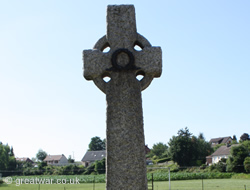
The memorial cross is located in the northern corner of Fricourt British Cemetery Bray Road. The cemetery is on the D147 Rue d'Arras in the south part of Fricourt village.
-
12th Battalion Gloucestershire Regiment Memorial, Longueval
50.02524195390362
2.7971363067626953
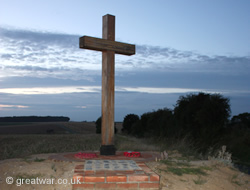
The wooden cross is located at the crossroads of the Rue de Bazentin and the Ruelle Cambray on the west edget of Longueval village. It is dedicated to the officers and soldiers of 12th Battalion the Gloucestershire Regiment, known as “Bristol's Own”, who died in the battles of July to September 1916 at Longueval, Guillemont and Morval.
-
102nd (Tyneside Scottish) & 103rd (Tyneside Irish) Brigades Memorial (34th Division), La Boisselle
50.0185314014656
2.6872247457504272
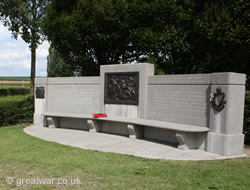
The memorial is to the men of two brigades in the 34th Division. It commemorates four battalions in the 102nd Brigade (Tyneside Scottish), these being the 20th, 21st, 22nd and 23rd Battalions Northumberland Fusiliers, and the four battalions of 103rd Tyneside Irish Brigade, these being the 24th, 25th, 26th and 27th Battalions Northumberland Fusiliers. The memorial is located at the southern part of the village of La Boisselle, where the men of the 34th Division attacked the German Front Line on 1 July 1916.
-
1st Australian Division Memorial, Pozières
50.03826402318774
2.721589207649231
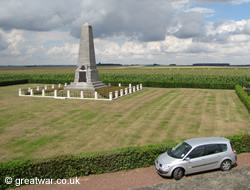
A viewing platform has been constructed so that visitors can see the spectacular views from this memorial's location, giving an appreciation of why this area of high ground at Pozières was so important for the Allies to capture.
-
2nd Australian Division Memorial, Mont St. Quentin
49.947393
2.932540
A statue of a bronze Digger stands on a plinth to commemorate the officers and men of the 2nd Australian Division who fought in this area between 31 August and 2 September 1918. This statue, by the scuptor Charles Web Butler, was unveiled in 1971. The first statue on the memorial plinth dating from 1925 depicted an Australian soldier stabbing an eagle with his bayonet. It was one of a few 1914-1918 memorials destroyed by soldiers of the German Army in 1940.
-
3rd Australian Division Memorial, Morlancourt Ridge
49.936132
2.579848
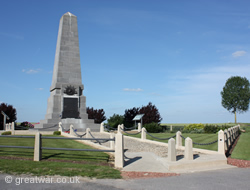
Memorial to the officers and men who served with the 3rd Australian Division. The memorial is located on the D1 road that runs along the Morlancourt ridge, on the northern bank of the River Somme.
-
4th Australian Division Memorial, Bellenglise
49.930633
3.226687
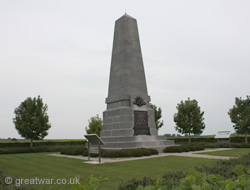
Memorial to the officers and men of the 4th Australian Division who fought in this area on 18-20 September 1918. The memorial is located on high ground approximately 1,800 metres north of the village of Bellenglise. It is accessible by vehicle using a farm track, although poor weather may result in the track being impassible.
-
12th (Eastern) Division Memorial, Epéhy
49.99764284481179
3.1433384120464325
-
16th (Irish) Division Memorial, Guillemont
50.01276102448721
2.8242480754852295
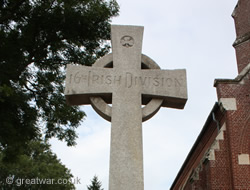
The memorial commemorates all those who fell while fighting with the 16th Irish Division at the Battles of Guillemont and Ginchy on 3 and 9 September 1916, and all Irishmen who gave their lives in the Great War. The memorial is situated next to the church in the village of Guillemont.
-
18th (Eastern) Division Memorial, Thiepval
50.05271763436168
2.6855765283107758
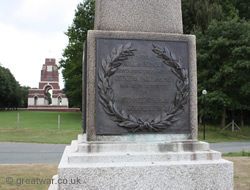
Memorial to the officers, non-commissioned officers and men of the 18th Division who fell in the Great War. This memorial is located at the hamlet of Thiepval close to the Thiepval Memorial to the Missing. The inscriptions on bronze plaques include the battle honours and units in the division.
-
18th (Eastern) Division Memorial, Trones Wood
50.006745168619545
2.8083693981170654
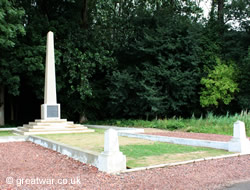
Memorial to the 18th (Eastern Division) on the south edge of Trones Wood. Great care should be taken when stopping at this memorial as it is situated on a bend in the road.
-
19th (Western) Division Memorial, La Boisselle
50.020642
2.695459
The 19th (Western) Division Memorial is a stone cross located close to the church on Rue Georges Cuvillier.
-
20th (Light) Division Memorial, Guillemont
50.01428721987991
2.834247350692749
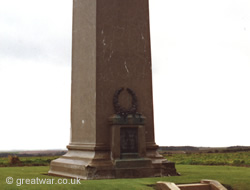
This photograph was taken of the original memorial obelisk before it was removed in 1992. Subsidence had caused the memorial to be considered a danger. A plinth with a plaque and wreath were unveiled in 1995. The original steps from the road up the bank and the memorial were kept.
-
29th Division Memorial, Newfoundland Memorial Park, Beaumont Hamel
50.072954376165846
2.648047059774399
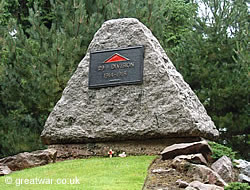
The memorial is located on the battlefield north of the Ancre river to the west of Beaumont Hamel village, where the 29th Division spent several weeks during the build-up to the 1916 Battle of the Somme. On 1 July 1916 the division suffered heavy casualties against the German defenders in the Beaumont Hamel sector.
29th Division Memorial -
34th Division Memorial, La Boisselle
50.021814
2.696902
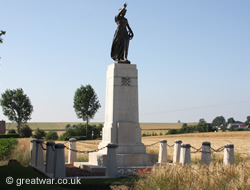
Memorial to the officers and men who served with the 34th Division. The memorial is located at the north end of the village of La Boisselle off Rue Georges Cuvillier.
-
36th (Ulster) Division Memorial, The Ulster Memorial Tower
50.061378023600675
2.6804709434509277
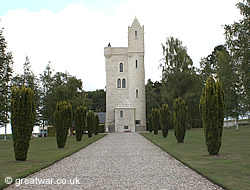
The Ulster Tower is a Somme battlefield memorial to the men of the 36th (Ulster) Division. The monument commemorates the heavy losses suffered by 36th (Ulster) Division on 1 July 1916, the first day of the Battle of the Somme.
-
36th (Ulster) Division Memorial to all Ranks and VC Winners
50.060902550343535
2.679772228002548
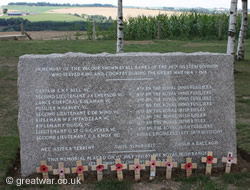
This is a stone with an inscription to all ranks of 36th (Ulster) Division and to the nine officers and soldiers of the division who were awarded the Victoria Cross. This memorial is located in the grounds of the Ulster Memorial Tower.
-
38th (Welsh) Division Memorial, Mametz Wood
50.01381461236164
2.756393551826477
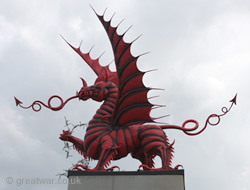
The red dragon memorial marks the place where the 38th (Welsh) Division set off to attack Mametz Wood on 7 July 1916 and suffered heavy losses. The wood was eventually cleared by the 14 July but at a cost of over 4,000 casualties.
-
41st Division Memorial, Flers
50.049680841351794
2.8216248750686646
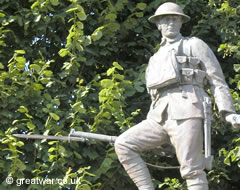
The 41st Division took part in the Battle of Flers-Courcelette from 15 - 22 September 1916. Two brigades were involved in the launch of the attack at the centre of the XV Corps. They started from the British Front Line north-east of Delville Wood. Between the objective for the attack, which was beyond the village of Guedecourt, and the start point of the British Front Line lay the village of Flers, which had to be captured. Several tanks advanced with the British troops from Zero Hour, taking part in the first advance of tanks combined with infantry by the British Army. Flers was captured and a tank drove up the village street with cheering British soldiers.
The bayonet of the soldier standing at the memorial points to the west, the direction from which the new weapon of tanks arrived to take part in the battle.
A photograph taken from the rear of the memorial looking south along the village street features on the front cover of a very well known guidebook to the battlefields by the late Rose E B Coombs, MBE, and titled “Before Endeavours Fade”.

Before Endeavours Fade [Paperback]
by Rose E B Coombs
Published by After the Battle (May 2006). 248 pages. ISBN-10: 1870067622, ISBN-13: 978-1870067621
-
46th (North Midland) Division Memorial, Bellenglise
49.925156
3.251630
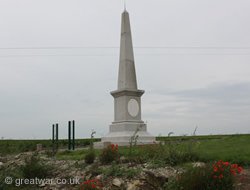
The memorial is dedicated to the officers and men of the division who lost their lives in battles in 1914-1918. It is also a monument to the victory of 29 September 1918, when the division attacked the canal between Ricqueval Bridge and Bellenglise, breaking through the Hindenburg Line and capturing over 4,000 prisoners and 70 guns.
-
47th (London) Division Memorial, High Wood (Bois de Foureaux)
50.03653782857504
2.786584496498108
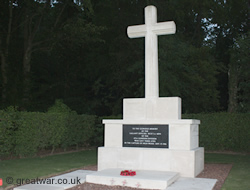
The memorial is located on the southern corner of High Wood, known by its French name of Bois de Foureaux. The wood was captured by the 47th Division on 15 September 1916 and the memorial is dedicated to the memory of the officers and men of the division who lost their lives at that time.
-
51st (Highland) Division Flagstaff Memorial, Beaumont-Hamel
50.08424935212101
2.656259983778
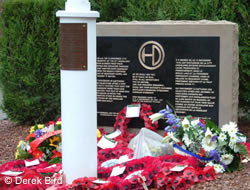
51st (Highland) Division attacked the village of Beaumont-Hamel on 13 November 1916 and captured it.
The original memorial flagstaff to 51st (Highland) Division, located in the centre of the village, was renovated. The reinstated memorial was unveiled on 13 November 2006, the 90th anniversary of the 1916 Battle of the Somme.
-
51st (Highland) Division Memorial, Beaumont-Hamel
50.077976912560274
2.650650143623352
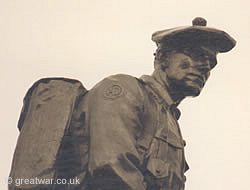
51st (Highland) Division attacked the village of Beaumont-Hamel on 13 November 1916. The men of the division captured the village, which had been an objective on 1 July at the launch of the offensive five months previously.
The sculptured figure of the Scotsman is located in the Newfoundland Memorial Park close to Y Ravine and the German Front Line which had withstood the British attack on 1 July and held out until the attack by this division in November.
51st (Highland) Division Memorial -
58th (London) Division Memorial, Chipilly
49.909041728161505
2.6495343446731567
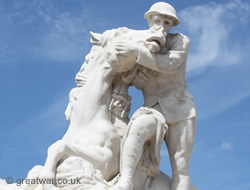
The memorial is dedicated to those who died when fighting with the 58th (London) Division and during the Battle of Amiens in August 1918. It depicts an artilleryman cradling the head of his wounded horse.
-
Accrington Pals Memorial, Sheffield Memorial Park, Serre
50.10575958963047
2.6566502451896667
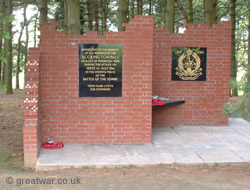
The red brick memorial is dedicated to the men of the Accrington Pals who fought and died in this part of the battlefront in the attack on Serre village on 1 July 1916. It is located in Sheffield Memorial Park, which in itself is a memorial to the men of the Pals Battalions in 31st Division who suffered very heavy casualties on that day.
Sheffield Memorial Park -
American Memorial, Bellicourt
49.975006
3.231450
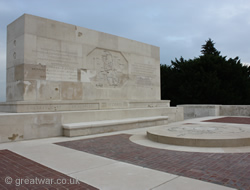
The memorial commemorates the officers and men of the US 27th Division and US 30th Division. These two divisions fought in the area between this memorial north of Bellicourt village and Riqueval, where the Canal de Saint Quentin runs through an underground tunnel. The fighting took place from 24 to 30 September 1918 and the German defences here were broken through.
The nearby Somme American Cemetery is the resting place of 1,844 casualties of the American Expeditionary Force (AEF).
-
Australian Corps Memorial Park, Le Hamel
49.898618230286615
2.5810226798057556
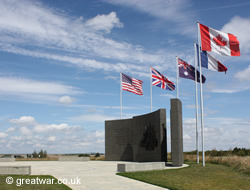
This memorial is to be found on high ground of gently rolling fields and has magnificent views across to the Morlancourt ridge. The memorial commemorates over 100,000 Australians who served with the Australian Corps in France. The site is at the location of the final objective of the Battle of Hamel on 4 July 1918.
-
Australian Memorial, Pozières Mill
50.04502004835465
2.7359390258789062
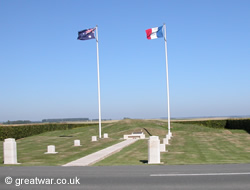
The Australian Memorial is on the location of a windmill at Hill 160, situated at the highest point of the D929 road between Bapaume and Albert. The views across the battlefields from the site of the mill are magnificent. From the time when the German Army arrived on this part of the Somme battlefield in late September 1914 the mill was used as a German artillery observation post. It was damaged and finally destroyed in the spring of 1916 by the British Army during the build-up to the Allied July Somme offensive. The ground on which the original windmill had stood was captured by Australian forces in the Battle of Pozières between 23 July and 7 August 1916.
-
Australian National Memorial, Villers-Bretonneux
49.88705100097928
2.512822151184082
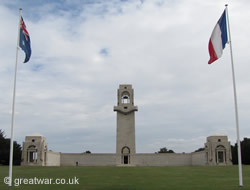
The Villers-Bretonneux Memorial is the Australian National Memorial on the Western Front. It commemorates all Australian officers and men who fought and died in France and Belgium during the First World War. The names of almost 11,000 Australians who fell in action and who have no known grave in France between 1916 and 1918 are inscribed on this memorial.
-
Butte de Warlencourt Western Front Association Memorial, Le Sars
50.07581492007727
2.7948778867721558
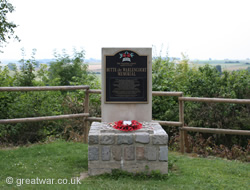
The Western Front Association owns the Butte de Warlencourt, an artificial hill on the Somme battlefield. It was used as a location of strategic high ground in the Franco-Prussian war of 1870-1871 and again in the Battles of the Somme in 1916 and 1918. The Butte was full of tunnels even before the Germans fortified it in the First World War. The Butte was taken by the British when the German Army retreated to the Hindenburg Line in February 1917, but was retaken during the German offensive in March 1918. The British 21st Division captured the Butte on 25 August 1918 during the Allied Advance to Victory.

The Butte has been owned by The Western Front Association since 1990. There is a memorial plaque on the summit.
-
Canadian Memorial at Courcelette
50.05415519014649
2.751871347427368
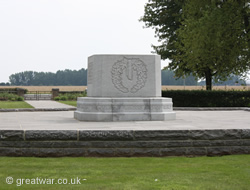
The Canadian memorial commemorates the actions on the Somme battlefield by Canadian forces in November 1916.
-
Caterpillar Valley (New Zealand) Memorial, Longueval
50.02546160210794
2.7923834323883057
On the east side of the Caterpillar Valley Cemetery is the Caterpillar Valley (New Zealand) Memorial. This memorial commemorates more than 1,200 officers and men of the New Zealand Division who died in the Battles of the Somme in 1916, and whose graves are not known. This is one of seven memorials in France and Belgium to those New Zealand soldiers who died on the Western Front and whose graves are not known. The memorials are all in cemeteries chosen as appropriate to the fighting in which the men died. The cemetery and the memorial were designed by Sir Herbert Baker.
-
Demarcation Stone, Villers Bretonneux
49.87059851462764
2.5261983275413513
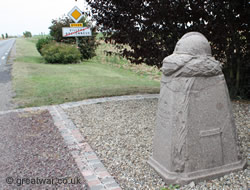
This demarcation stone sits at the eastern entrance to the village of Villers Bretonneux on the Roman road to Péronne, the Route de Péronne. This stone marks the furthest point to which the German Army advanced in its attempt to break deep into the Allied-held territory, being held at Villers Bretonneux by British and Australian troops in early April 1918. For that reason, it also marks the point from which the British Army launched its offensive a few months later in August of that year, which was to form the beginning of the last 100 days of the war and the successful Allied Advance to Victory.
For more information about Demarcation Stones read our article:
-
Guards Division Memorial, Ginchy
50.03174045037835
2.842562198638916
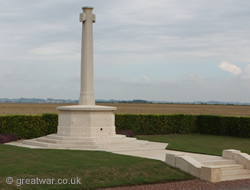
The memorial to the Guards Division stands on high ground at a location where a wooden cross was placed immediately after the battles of September 1916. The memorial stands in memory of the officers and men of the Guards Division who fought in the battles at Ginchy and Les Boeufs. Many Guardsmen were not found after the war and their remains still lie in the fields around the memorial.
-
K.R.R.C. (King's Royal Rifle Corps) Memorial, Pozières
50.03659341690653
2.7214282751083374
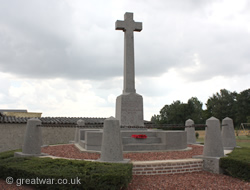
The memorial is dedicated to the officers and men of the battalions of the King's Royal Rifle Corps (K.R.R.C.) who gave their lives on the battlefields of France.
-
Lochnagar Crater, La Boisselle
50.01595377632973
2.6972293853759766
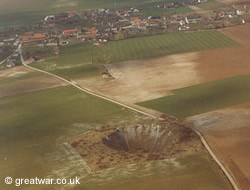
Lochnagar Crater, is an impressive hole in the ground created at 07:28 on the 1st July 1916 after 24,500 Kg of ammonal explosive was detonated underground. This mine was one of eight huge mines exploded under the German Front Line positions on 1st July 1916 at the launch of the Battle of the Somme. Most of the other mines have been filled in or are innaccessible on private land.
-
Liverpool Pals & Manchester Pals Memorial, Montauban de Picardie
50.00625950048464
2.783041298389435
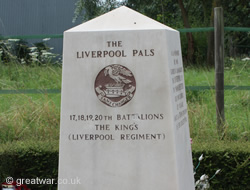
This memorial is located in the village of Montauban, which was liberated by the Liverpool Pals and the Manchester Pals battalions. These battalions were fighting with 30th Division on 1 July 1916 and were some of the few British units to successfully achieve their objective by the end of the first day of the Battle of the Somme.
-
McCrae's Battalion & the Contalmaison Cairn, Contalmaison
50.022443
2.729664
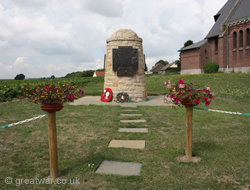
A cairn raised by the McCrae's Battalion Trust in memory of the officers and men in the 16th (Service) Battalion Royal Scots. The Battalion was named McCrae's Battalion after Lt Col George McCrae MP, who raised it from volunteers in Edinburgh, December 1914. Some of the men were professional football players. McCrae's Battalion took part in the 1 July 1916 offensive in 101st Brigade, 34th Division.
For lots of information about the story of McCrae's Battalion, the memorial and the men it commemorates visit this excellent website:
Website: www.mccraesbattaliontrust.org.uk
-
Newfoundland Caribou Memorial, Beaumont Hamel
50.07383874613065
2.6482415199279785
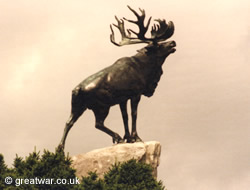
The Caribou memorial at Beaumont Hamel is one of five caribou memorials to commemorate the sites where the Newfoundland Regiment fought on the Western Front. The memorial is dedicated to the Newfoundlanders who fought at Beaumont Hamel in July 1916. This Caribou is located in the Newfoundland Memorial Park.
Newfoundland Memorial Park -
Newfoundland Caribou Memorial, Gueudecourt
50.06508613962658
2.853752374649048
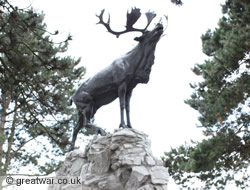
The memorial at Gueudecourt is a caribou like the one at Newfoundland Memorial Park, Beaumont Hamel. It is one of five caribou memorials to commemorate the sites where the Newfoundland Regiment fought on the Western Front.
-
Newfoundland Memorial Park, Beaumont Hamel
50.07394547537557
2.6492205262184143
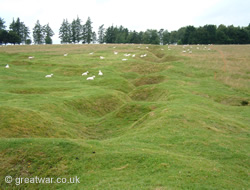
This memorial park commemorates the Royal Newfoundland Regiment which, along with several British battalions, attacked the German Front Line in this sector as part of the 1 July 1916 Somme offensive. The Newfoundland Regiment suffered appalling losses on that day. The land was originally bought in 1921 by Newfoundland and officially opened by Earl Haig in 1925.
The park contains three British cemeteries, memorials to the 29th Division and the 51st (Highland) Division, the Newfoundland Regiment Caribou Memorial and plaque to the Missing of Newfoundland, preserved trench outlines, the petrified Danger Tree and a visitor centre.
Newfoundland Memorial Park -
New Zealand Battle Memorial, Longueval
50.039472
2.801535
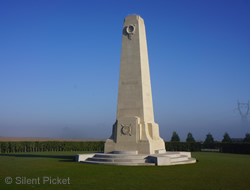
The New Zealand Division was in action from the start of the Battle of Flers—Courcelette on 15 September 1916 until its relief on 1/2 October 1916. Losses for the Division during the battle were almost 7,000 casualties.
The memorial is situated north of Longueval village on the crest of a ridge between High Wood (Bois de Foureaux) and Delville Wood. From the centre of Longueval village take the D197 in the direction of Flers/Bapaume. After about 300 metres the D197 bears to the right and there is a turning to the left with a signpost for the New Zealand Forces Memorial. Follow this single track tarmac lane, passing a Calvary Cross on the right hand side, and the memorial will be seen a few hundred metres ahead on the skyline.
Photograph courtesy of John Knight, The Silent Picket. Website: www.silentpicket.com
-
New Zealand Memorial to the Missing, Grévillers
50.1089630161074
2.819661498069763
The memorial is situated in Grévillers British Cemetery. It commemorates 450 officers and men of the New Zealand Division who died in the fighting in this area between March and August 1918 and in the Advance to Victory between 8 August and 11 November 1918, and who have no known grave. It is one of seven memorials on the Western Front to the missing New Zealand Forces.
-
Piper's Memorial, Longueval
50.02622461900996
2.8034716844558716
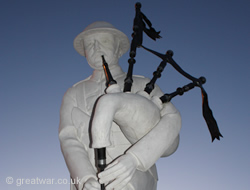
The Piper's Memorial, sculpted by Andy De Comyn, was unveiled in July 2002. It is dedicated to the memory of all pipers, of all nationalities and military units, who were killed in battle during the First World War. The statue is a figure of a piper in battle dress as he climbs out of the trench leading the men of his unit over the parapet.
The plaque at the base of the memorial quotes from a poem by Lieutenant Ewart Alan Mackintosh, MC, who served with the 5th Battalion the Seaforth Highlanders.
-
Pozières Memorial to the Missing
50.03445390860742
2.714792490005493
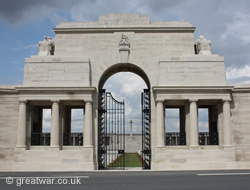
The Memorial to the Missing commemorates over 14,000 British and 300 South African casualties who died on the Somme battlefield between 21 March and 7 August 1918, and who have no known grave.
-
Proyart Village Memorial
49.888743
2.705002
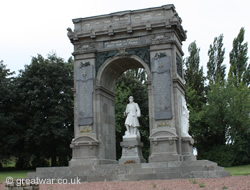
The War Memorial in the village of Proyart, south of the River Somme, commemorating the men of Proyart who died fighting in the First and Second World Wars.
-
Riqueval Bridge Western Front Association Memorial
49.940050
3.242335
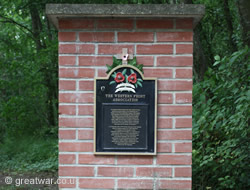
The Western Front Association unveiled a memorial in 1993 on the anniversary of the capture of the Riqueval Bridge over the Canal de Saint Quentin, 29 September 1918. The 46th (North Midland) Division captured this bridge on that day, the only bridge remaining intact over the canal. This greatly assisted the British Army in crossing the canal, which had formed part of the strong German defensive position here. The Allies then began the move eastwards, starting the next phase of the Allied offensive in the autumn of 1918.
-
Sheffield Memorial Park, Serre
50.10580970758465
2.656524181365967
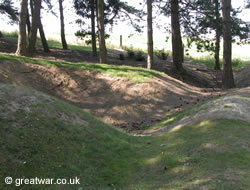
The Memorial Park is in the location of the British Front Line for 1 July 1916. At the time there were four small woods in this sector. They were known on British Army maps from south to north as Matthew Copse, Mark Copse, Luke Copse and John Copse.
Sheffield Memorial Park -
South African Memorial, Delville Wood, Longueval
50.02738462966803
2.8125429153442383
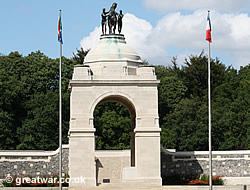
The Memorial remembers the heavy losses sustained by the South African Brigade of the 9th Scottish Division from 14 to 20 July 1916. Out of over 3,000 men only 29 officers and 731 other ranks returned.
The memorial is located in the wood, the grounds of which have been preserved and replanted with trees. The original “rides” through the trees have been kept in the locations where they were on the British Army trench maps. Much of the ground in the wood has been left after the war leaving craters and trench lines to be seen.
The South Africa (Delville Wood) National Memorial, Longueval
-
Tank Corps Memorial, Pozières
50.04461698734404
2.7364003658294678
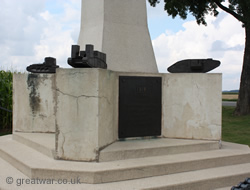
On 15 September 1916 tanks went into action with the British infantry for the first time. The attack took place in the area of Flers east of the Bapaume-Albert road.
-
Thiepval Memorial to the Missing
50.05057712234829
2.685770988464355
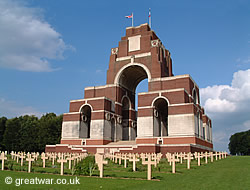
The Thiepval Memorial to the missing of the Somme, bears the names of more than 72,000 officers and men of the United Kingdom and South African forces who died in the First World War in the Somme sector before 20 March 1918 and have no known grave.
Thiepval Memorial to the Missing -
Victoria School, Villers-Bretonneux
49.88705100097928
2.512822151184082
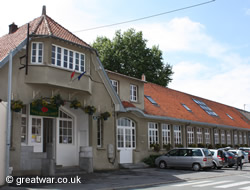
The destroyed primary school in Villers-Bretonneux was rebuilt with money gifted from children in the Australian State of Victoria between 1823 and 1927. The first floor of the school houses the Franco-Australian Museum. (The museum is being renovated during 2016.)
-
Villers-Bretonneux Village Memorial
49.868503252294914
2.5178848206996918
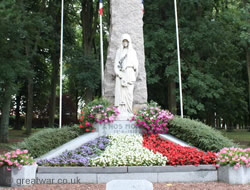
This memorial in the centre of Villers-Bretonneux village is dedicated to the 124 French men from the village and surrounding area who served with the French Army in 1914-1918 and who did not return home. Several sets of surnames show that up to four men were lost from some families. At the foot of the memorial a stone is inscribed to the memory of the Australian soldiers who died in the liberation of the village in 1918.
Related Topic
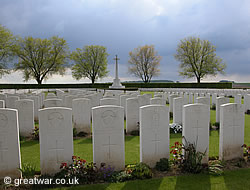
Cemeteries on the Somme Battlefields
|
There are many military cemeteries on the Somme 1914-1918 battlefields. For a comprehensive list and locations go to:
Cemeteries on the Somme BattlefieldsAcknowledgements
The Commonwealth War Graves Commission. Some of the information given on this page about memorials for British and Commonwealth military dead is based on information provided in the cemetery registers produced by the Commonwealth War Graves Commission. To find out more about the work of the CWGC, the free education resources, or to search for the place of commemoration or burial of a serviceman or woman visit the website:
Website: www.cwgc.org