WW1 Museums on the Somme Battlefields, France
There are a number of public and private First World War museums on the battlefields of the Somme. There are collections ranging from rare battlefield relics and archive collections to original battlefield remains and commemorative sites.
-
Franco-Australian Museum
Villers-Bretonneux
49.86614199710635
2.517247796058655
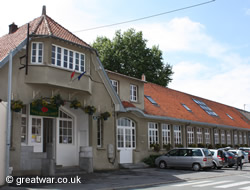
The museum was established by the Franco-Australian Association and was opened on ANZAC Day, 25 April 1975.
-
Historial de la Grande Guerre
Péronne
49.929175666339354
2.931903
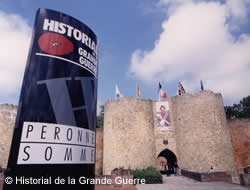
An international museum of comparative history. All presentations are made in three languages - French, English and German — to show the experiences of the major participants in the First World War and the impact of this conflict on the 20th century.
-
Le P'tit Train de la Haute Somme
Froissy
49.92341528699047
2.7311861515045166
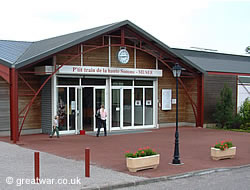
This narrow gauge railway museum has a collection of about 20 locomotives and 25 wagons together with information on the use of the railway during WW1.
Tickets can be purchased here to ride on the last remaining section of the large military narrow gauge network built during WW1 in preparation to supply the trenches with ammunition in the Somme offensive of 1916.
Address: P'tit train de la Haute Somme - APPEVA, BP 70106, 80001 Amiens Cedex 1, France
Telephone: +33 (0)3 22 83 11 89
Email: appeva@club-internet.fr
Website: appeva.club.fr
-
Musée Somme 1916, Albert
Albert
50.00385981878213
2.6483649015426636
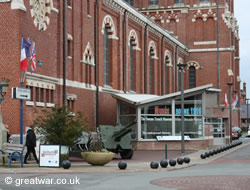
In tunnels 10 metres underground and 250 metres long this museum reconstructs realistic scenes from the lives of soldiers on the Somme battlefields.
The museum is in four languages (French, English, German and Dutch).
Address: Rue Anicet Godin, 80300 ALBERT
Telephone: +33 (0)3 22 75 16 17
Email: musee@somme1916.org
Website: www.musee-somme-1916.eu
-
Museum to the South African Forces, Delville Wood
Longueval
50.02739657658006
2.8125107288360596
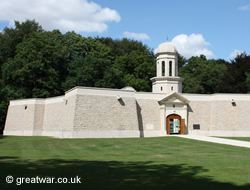
Located in the centre of Delville Wood, the museum commemorates the sacrifice of 25,000 South African volunteers, who lost their lives in two world wars and in Korea.
-
Newfoundland Memorial Park Visitor Centre
Beaumont Hamel
50.072245353586474
2.6484882831573486
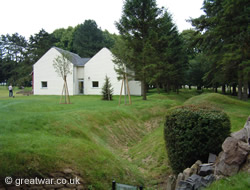
The Visitors' Centre is part of Newfoundland Memorial Park near Beaumont Hamel. The displays within the Centre focus on the historical and social situation of Newfoundland at the start of the 20th century. It covers the history of the Royal Newfoundland Regiment from when it was formed in 1914 to the end of the First World War.
-
“Ocean Villas” WW1 & WW2 Museum
Auchonvillers
50.080237375701756
2.631739228963852
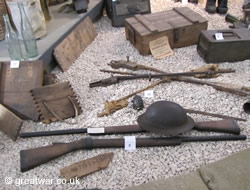
The museum comprises a collection of rare and important militaria and memorabilia from the First and Second World Wars.
-
Sir John Monash Centre
Villers-Bretonneux Military Cemetery and Memorial
49.88692657489389
2.5126880407333374
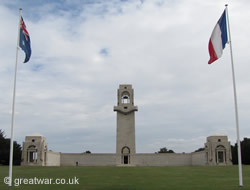
A new Visitor Centre telling the story of the Australian Forces on the Western Front in the words of those who served. The Centre will be opened in April 2018. It will reveal the Australian experience on the Western Front through interactive media installations and immersive experiences.
Website: sjmc.gov.au
-
Thiepval Visitor Centre & Museum
Thiepval
50.05256114362967
2.688131332397461
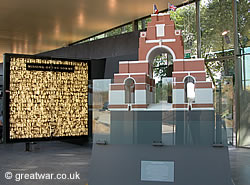
The Visitor Centre provides a place for the thousands of visitors to the Thiepval Memorial to the Missing where the memorial is put in the context of the battlefield.
The museum is one of two museums on the Somme battlefields managed by the Historial de la Grande Guerre. The Thiepval Museum is accessed from the Thiepval Visitor Centre. The museum provides information, maps, photographs and audivisual experiences to help visitors understand the battles that took place in the Department of the Somme.
-
The Ulster Memorial Tower Visitor Centre
Thiepval
50.061378023600675
2.6804709434509277
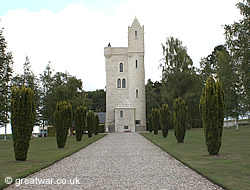
The Visitor Centre comprises a small museum of display cases containing artefacts recovered from the Somme battlefields, and most particularly items related to the soldiers of the 36th (Ulster) Division.
Related Topic
|
For events on the Somme battlefields see our page: